
Does AI Waste Water?
How AI Water Cooling Systems Work and Their Environmental Impact

Written with the help of AI
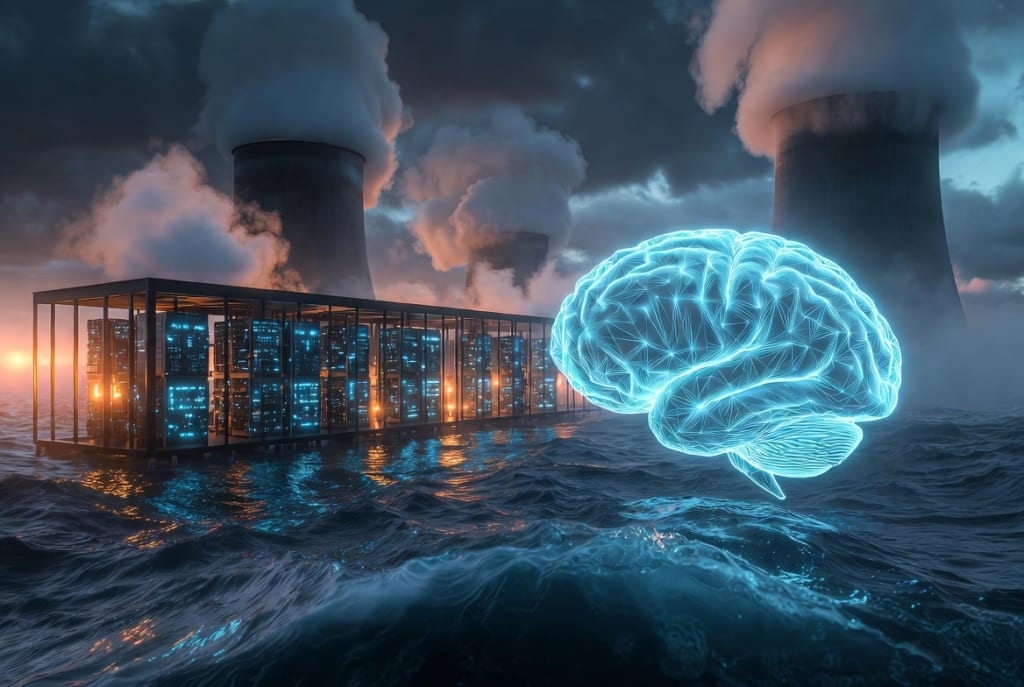
From evaporative cooling towers to advanced liquid systems, AI's thirst for water is growing rapidly alongside its massive energy demands
Artificial intelligence powers everything from chatbots and image generators to scientific research and autonomous vehicles. Behind the scenes, the massive data centers running these AI models generate enormous amounts of heat. Keeping servers cool is essential to prevent damage and maintain performance. This is where water cooling systems come in, and they come with significant environmental trade-offs.
How AI Water Cooling Systems Work
Modern AI workloads, especially training and running large language models, push computer chips harder than ever before. High-performance GPUs and TPUs can produce intense heat, far more than traditional servers.
The most common cooling method in many data centers is evaporative cooling. Hot air from the servers passes through cooling towers where water is sprayed or circulated. As the water evaporates, it absorbs heat and cools the air, which is then recirculated. Much of this water literally disappears into the atmosphere as vapor. This process is energy-efficient compared to running large air conditioners, but it consumes large volumes of freshwater.
Another approach is direct-to-chip liquid cooling. Cool liquid (often water or a water-based mixture) flows through metal plates attached directly to the processors. The liquid absorbs heat at the source and carries it away to a heat exchanger, where it is cooled before recirculating. In closed-loop systems, the same liquid is reused with minimal loss.
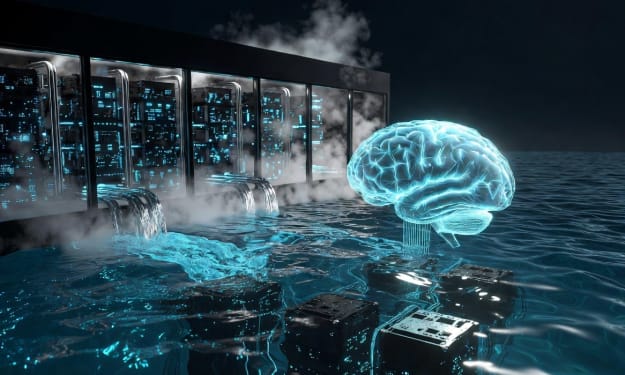
Immersion cooling takes this further by submerging entire servers in non-conductive dielectric fluids. These fluids absorb heat efficiently without conducting electricity, and the system can operate with far less water evaporation.
Data centers also use hybrid systems that combine air cooling, liquid cooling at the chip level, and building-wide evaporative or dry cooling towers. The choice depends on location, energy costs, water availability, and the density of AI hardware.
The Growing Scale of AI's Water Use
AI is dramatically increasing water consumption in data centers. A single large data center can use hundreds of thousands to millions of gallons of water per day for cooling alone. Projections show U.S. data centers could consume tens or even hundreds of billions of gallons annually in the coming years as AI expands.
Each AI query or image generation adds to the total. While individual prompts may use only a small amount of water (estimates range from a few drops to roughly one bottle per 100-word prompt in some studies), billions of daily interactions add up quickly.
There is also indirect water use. Generating the electricity that powers data centers often requires water for cooling power plants or hydropower. In water-stressed regions like parts of the American Southwest, this combined demand can strain local supplies and ecosystems.
Broader Environmental Impact of AI
Water is only part of the story. AI's environmental footprint includes:
Energy consumption: Training and running advanced models requires massive electricity. Data centers already account for a growing share of global power demand, and AI is accelerating this trend. Much of this electricity still comes from fossil fuels in many regions, leading to carbon emissions.
Carbon footprint: Estimates suggest AI systems could contribute tens of millions of tons of CO₂ equivalent annually, comparable to the emissions of millions of cars or even entire cities in some projections.
Other impacts: Construction of data centers uses land and materials, while discarded hardware contributes to electronic waste. The rapid growth also raises questions about resource extraction for chips and batteries.
The good news is that the industry is responding. Companies are investing in more efficient liquid cooling, closed-loop systems that reuse water, immersion cooling, and locating facilities in cooler climates or areas with abundant renewable energy and recycled water. Some facilities aim for near-zero water consumption through advanced designs.
However, efficiency gains are often offset by the explosive growth in AI usage. As models become more powerful and widely adopted, total resource demands continue to rise.
What This Means Moving Forward
AI brings enormous benefits in healthcare, climate modeling, education, and innovation. Yet its environmental costs cannot be ignored. Water use for cooling highlights a key tension: technologies designed to solve big problems can create new ones if not managed carefully.
Transparency from tech companies, smarter facility siting, faster adoption of renewable energy, and continued innovation in cooling technologies will be critical. Policymakers, utilities, and communities also need to plan for the infrastructure demands of the AI era.
Understanding how AI water cooling systems work and their place in the larger environmental picture helps us make more informed choices as users, developers, and citizens. The future of AI does not have to come at the expense of our planet, but achieving balance will require deliberate effort and responsible innovation.
About the Creator
Sandy Rowley
AI SEO Expert Sandy Rowley helps businesses grow with cutting-edge search strategies, AI-driven content, technical SEO, and conversion-focused web design. 25+ years experience delivering high-ranking, revenue-generating digital solutions.
Keep reading
More stories from Sandy Rowley and writers in 01 and other communities.
Governance in Web3: How Decentralized Communities Are Shaping the Future of Blockchain Networks
One of the most transformative ideas introduced by blockchain technology is decentralized governance. In traditional organizations, decisions about policies, development direction, and resource allocation are typically made by executives or centralized management teams. With Web3, a new model is introduced in which communities directly take part in making decisions.
By Nimra kanwal6 days ago in 01
A Simple Guide to Understanding HELOC Loan Rates
A Home Equity Line of Credit (HELOC) can be a powerful financial tool, offering homeowners flexible access to the equity they’ve built over time. But before opening one, it’s essential to understand how HELOC loan rates work. Rates influence everything from your monthly payment to the long‑term cost of borrowing, so having a clear grasp of the basics helps you make confident, informed decisions.
By Kara Masterson5 days ago in 01
GRANDMA NELSON
Daddy pulled off the interstate, and I saw the all familiar red barn, and I knew we had arrived at Grandma Nelson's farm. I always had mixed feelings about seeing my Grandmother. It seemed she had as many Grandchildren as the old Mother in the shoe nursery rhyme. I saw her as different, but that is not why I hestiated. The truth be known I always got in trouble at her house, and ended up sitting in the car after I had been scolded.
By Susan Payton3 days ago in Fiction



Comments
There are no comments for this story
Be the first to respond and start the conversation.