
Oil Shock, Solar Surge
How the war in Iran is accelerating renewable energy

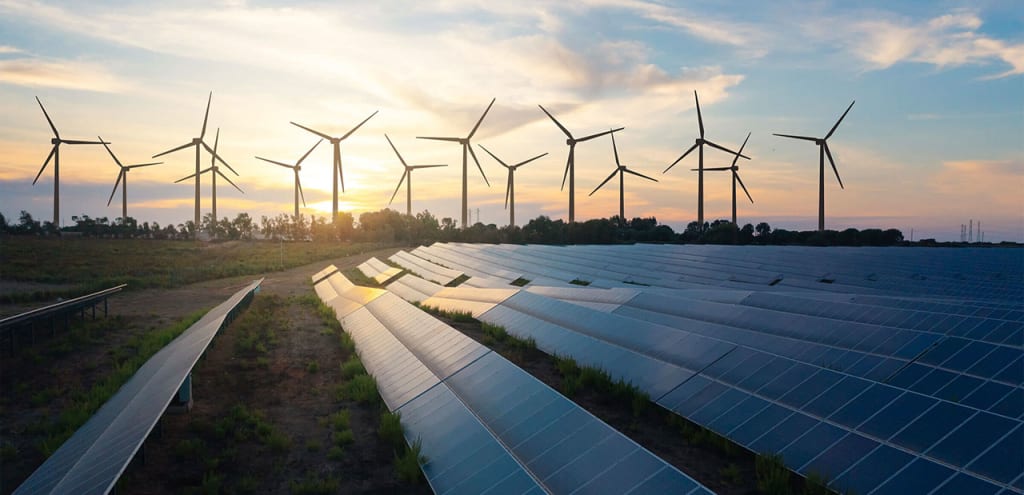
This conflict-driven oil shock (Feb–Mar 2026) closed the Strait of Hormuz and cut about 25% of global oil and gas supplies[1]. Prices spiked (Brent ~$100) and Gulf fields shut in[2]. Experts say this crisis proves why renewable energy (solar, wind, batteries, hydrogen) must now be fast-tracked to secure power and cut emissions[3][1].
Geopolitical Context
The U.S.-Israel conflict with Iran has escalated, and Iran’s retaliation effectively closed the Strait of Hormuz – a chokepoint for ~20% of the world’s oil[1]. In reaction, Gulf producers (UAE, Saudi) sharply cut output to protect tankers, creating the largest supply gap since the 1970s. This high-stakes drama highlights the link between politics and energy: as Secretary Kerry notes, oil dependency is a “security challenge” that demands energy independence[3].
Immediate Market Impacts
The oil and gas market tightened instantly. Saudi output plunged ~20% and Iraq ~70%[2], removing roughly 7–10 million barrels/day from the market. LNG flows were hit too (Qatar halted exports[1]). The IEA even tapped reserves, yet prices remain at $90–$100/barrel, underlining how fragile global fuel security is[2][1].
Energy-Security Lessons
This crisis underscores that energy is national security. This shut-in is the biggest oil shock since 1973[4], prompting calls for change. Leaders are drawing lessons from past crises: Europe’s 2022 gas war led to a sprint on renewables. Now experts argue we must similarly expand local clean power and EVs so that geopolitical conflicts can’t black out our lights[3][1].
Renewable Opportunities & Tech
The Middle East’s renewable resources can turn this crisis into opportunity. For example, Pakistan’s rooftop solar boom (~41 GW of panels since 2023[5]) has insulated its grid – a “poster-child for the solar revolution” that cut the country’s gas use[6]. Meanwhile, Saudi Arabia and the UAE are scaling up massive solar, wind, and green hydrogen projects[7][8]. Renewables have no fuel cost[9]: solar and wind keep generating even if ships are blocked. Paired with batteries and smart grids, they provide continuous power through crises.
On rooftops in Karachi, Pakistan, solar panels gleam. Millions of homes now have solar+battery setups, giving the grid a crucial “cushion” against shortages[10]. Other countries are following suit: China leads in EVs and clean grids, and European politicians are now saying “let’s not make the same mistake again” of over-relying on imports[11].
Renewable energy also brings co-benefits: clean air, local jobs, and stable prices. Costs have plummeted – onshore wind ~$0.034/kWh and solar ~$0.043/kWh by 2024[9] – making new clean power often cheaper than old fuels. With nearly zero fuel costs, each solar dollar today insulates us from tomorrow’s price shocks[9][12].
Policy & Investment Recommendations
Experts urge concrete actions now. The Global Renewables Alliance calls for fast-tracking projects, grid upgrades, green finance, electrification, and robust supply chains[13]. In practice, that means:
- Permitting & Grid: Expedite wind/solar approvals and invest in transmission/storage[13].
- Finance Shift: Redirect fossil subsidies into renewables, efficiency, and storage.
- Electrify Transport/Heating: Incentivize EVs, heat pumps, and mass transit.
- Inclusive Growth: Require local jobs, training, and community revenue-sharing[14].
Governments, investors, NGOs and communities each have roles. States can set clear clean-energy targets, investors can fund solar farms and factories, NGOs can push for transparency, and citizens can adopt rooftop solar or EVs. As one analyst notes, “with a stroke, this war has increased the power…of those who want to go down the solar route.” The transition pays off: renewables avoid future fuel expenses and stabilize economies[12][9].
Equity & Justice Considerations
A just transition is crucial. The Middle East is very unequal, so green projects must benefit ordinary people, not just elites. Past renewable projects drew protests – e.g. Moroccan solar farms faced land-rights issues[15], and Tunisia’s hydrogen plans raised water-rights concerns. Activists demand transparency and inclusion[14]: contracts should be open, communities must consent, and a share of profits should fund local development. In short, ensure the clean-energy boom also shrinks social gaps.
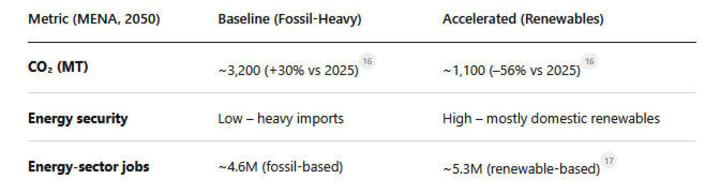
This shows that in the renewables scenario, emissions drop and energy security and jobs rise relative to business-as-usual[16][17].
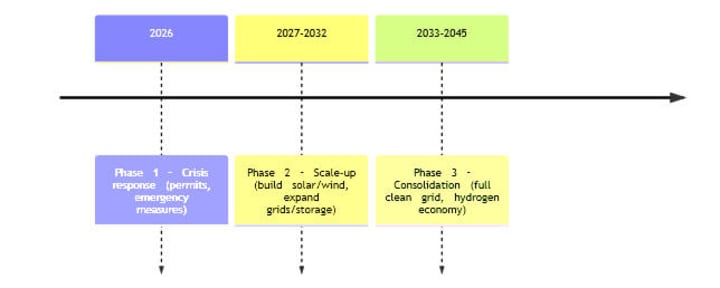
Assumptions: We assume the war’s disruptions last through 2026 and that policy-makers respond by fast-tracking clean energy. We also assume no extraordinary budget or resource constraints beyond those mentioned.
Learn more: Read the full report
________________________________________
[1] [5] [6] [10] [11] [12] Oil and gas prices are soaring. Some countries are ready with solar panels and EVs
https://www.kvpr.org/npr-news/2026-03-16/oil-and-gas-prices-are-soaring-some-countries-are-ready-with-solar-panels-and-evs
[2] Exclusive: UAE crude output falls by more than half as Hormuz closure forces shut-ins | Reuters
[3] Countries must seek energy independence through renewables and nuclear, says John Kerry | US-Israel war on Iran | The Guardian
[4] The Iran War Is Making the Case for Renewable Energy, Experts Argue - Inside Climate News
https://insideclimatenews.org/news/11032026/iran-war-oil-prices-renewable-energy/
[7] [8] Green Hydrogen Prospects in the Gulf - ORF Middle East
https://orfme.org/expert-speak/green-hydrogen-prospects-in-the-gulf/
[9] 91% of New Renewable Projects Now Cheaper Than Fossil Fuels Alternatives
[13] GRA launches Renewables Action Plan to break the energy crises cycle - Global Renewables Alliance
[14] [15] Why MENA’s Energy Transition Must Put Justice at Its Core | Resource Justice Network
https://resourcejustice.org/why-menas-energy-transition-must-put-justice-at-its-core/
[16] [17] Annex: Regional Factsheets (Global Renewables Outlook)
https://www.irena.org/-/media/Files/IRENA/Agency/Publication/2020/Apr/IRENA_GRO_R07_MENA.pdf
About the Creator
Futoshi Tachino
Futoshi Tachino is an environmental writer who believes in the power of small, positive actions to protect the planet. He writes about the beauty of nature and offers practical tips for everyday sustainability.
Keep reading
More stories from Futoshi Tachino and writers in Earth and other communities.
The Methane Accountability Shift
Methane rarely gets top billing, yet the toolkit to curb it has matured rapidly—and mostly out of the spotlight. A decade ago, most oil-and-gas methane was estimated, not measured. Today, facility-scale detections are published to open portals, regulators are writing leak detection and repair (LDAR) into law, and importers face disclosure—and soon performance—requirements. The result is a practical pathway to large, near-term climate cuts by turning leaks into reportable, repairable line items [1–4,12].
By Futoshi Tachino26 days ago in Earth
The Star That Keeps Dimming for No Known Reason
In 2015, astronomers analyzing data from NASA's Kepler Space Telescope discovered a star designated KIC 8462852, located about 1,470 light-years from Earth in the constellation Cygnus, that was exhibiting brightness fluctuations unlike anything that had been observed in over 150,000 stars surveyed by the Kepler mission, and the pattern of dimming was so unusual and irregular that it could not be explained by any known natural phenomena including planets orbiting the star, stellar pulsations, or dust clouds, leading some scientists to seriously propose that the dimming might be caused by artificial structures built by an advanced alien civilization, specifically something like a Dyson swarm of solar collectors orbiting the star to harvest its energy, though this explanation while exciting was considered a hypothesis of last resort only to be entertained after all natural explanations had been exhaustively ruled out. The star, which became known informally as Tabby's Star after astronomer Tabetha Boyajian who led the research team studying it, showed dimming events where its brightness dropped by up to 22 percent, far more than could be explained by a planet passing in front of it, which typically causes dimming of only a fraction of a percent, and the dimming events were irregular and aperiodic, meaning they did not repeat on any predictable schedule, and different dimming events had different characteristics with some showing gradual dimming over days and others showing more sudden brightness drops.
By The Curious Writerabout 20 hours ago in Earth
Iowa Weather Alert: Strong Winds Ease Tonight, But Winter Storm Could Bring Blizzard Conditions Sunday
Residents across eastern Iowa are experiencing an active and rapidly changing weather pattern this weekend. While strong winds are expected to gradually diminish Friday evening, meteorologists are warning that a significant winter storm could impact the region beginning Sunday, potentially bringing snow, powerful winds, and dangerous travel conditions.
By Omasanjuwa Ogharandukun3 days ago in Earth



Comments
There are no comments for this story
Be the first to respond and start the conversation.