
How to Recognize When a Monolith Should Be Migrated to Microservices
A Practical Checklist for Identifying the Breaking Point of a Monolith

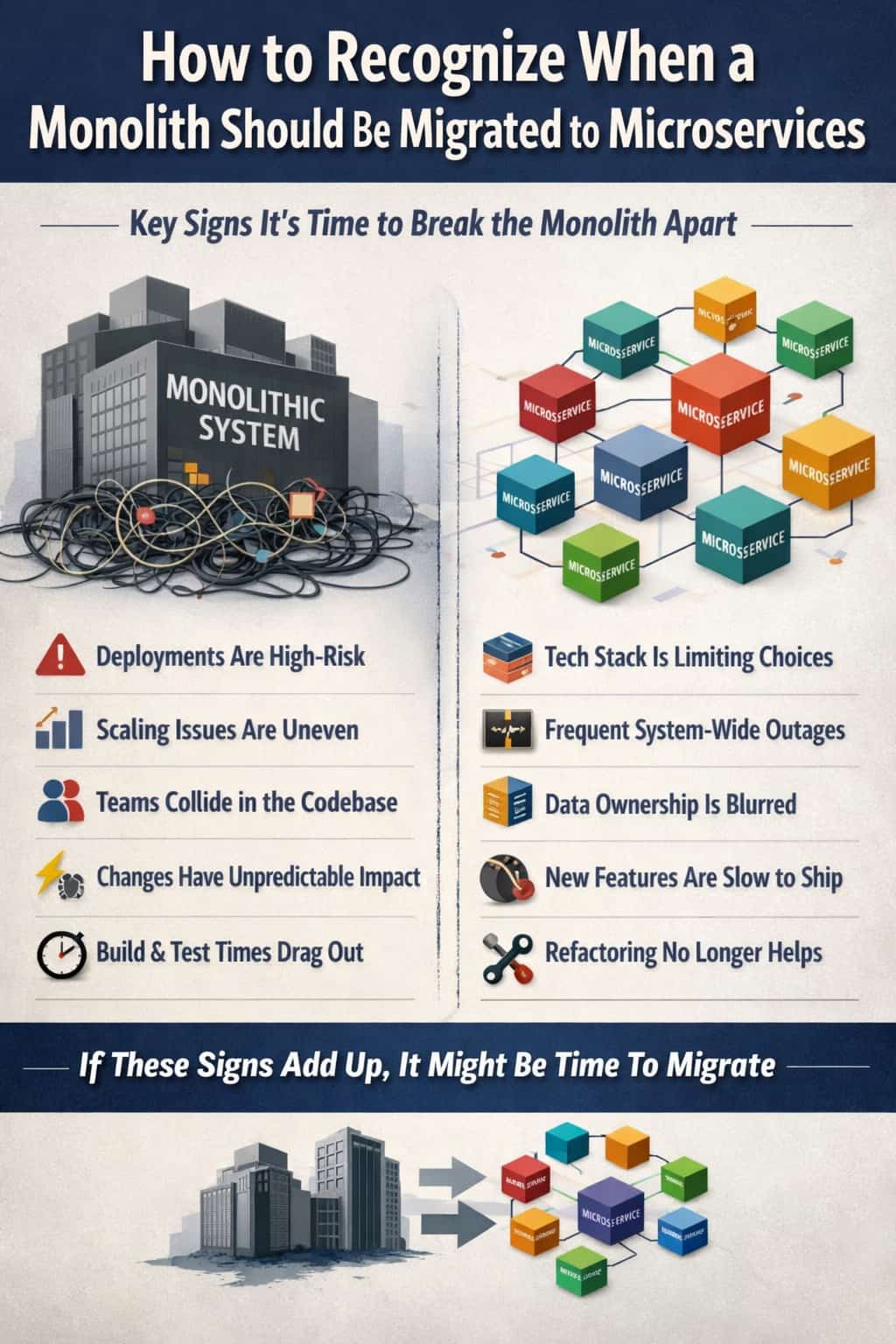
Monolithic systems are not inherently flawed. On the contrary, many of the most successful software products began as monoliths—and for good reason. A monolith is simpler to build, easier to reason about in early stages, and avoids the operational overhead of distributed systems. The problem arises when the assumptions that once made the monolith efficient no longer hold.
Migration to microservices is not a goal in itself. It is a response to accumulated friction—technical, organizational, and operational. The challenge is not in executing the migration, but in recognizing when it is justified. Premature decomposition leads to complexity without benefit; delayed migration leads to stagnation.
This article outlines the concrete signals that indicate a monolithic system has reached the point where migration to microservices becomes a rational, necessary step.
1. Deployment Has Become a Bottleneck
One of the earliest and most reliable indicators is the degradation of deployment velocity.
In a healthy monolith, deployments are routine. Changes are integrated, tested, and released with minimal coordination. When this breaks down, deployments become high-risk events requiring synchronization across teams, extensive regression testing, and contingency planning.
Typical symptoms include:
- Long-lived feature branches to avoid integration conflicts
- Deployment freezes before releases
- Increased reliance on manual testing
- Frequent rollbacks due to unrelated failures
The underlying issue is tight coupling. Even when modules are logically separated, they remain physically bound within a single deployable unit. A minor change in one area can have unpredictable effects elsewhere.
Microservices address this by enabling independent deployment. When deployment friction begins to slow down product delivery, it is often a sign that the monolith’s coupling has exceeded manageable limits.
2. Scaling Requirements Diverge
Not all parts of a system scale equally. In a monolith, however, scaling is typically applied uniformly.
Consider a system where:
- The recommendation engine requires heavy computation
- The authentication module handles frequent but lightweight requests
- The reporting system experiences periodic spikes
In a monolith, scaling means replicating the entire application—even if only one component requires additional resources. This leads to inefficiency and increased infrastructure cost.
A clear signal for migration is when:
- Specific components consistently become performance bottlenecks
- Infrastructure scaling becomes expensive relative to actual needs
- Resource utilization is uneven across the system
Microservices allow selective scaling. Individual services can be scaled independently based on their specific load characteristics. When scaling inefficiencies become systemic, the architecture is no longer aligned with operational reality.
3. Team Structure Conflicts with System Architecture
Architecture and organization are deeply intertwined. When a monolith grows, it often outpaces the team structure that maintains it.
Symptoms include:
- Multiple teams working in the same codebase, causing conflicts
- Difficulty assigning clear ownership of features or modules
- Coordination overhead increasing with every new feature
- Slower onboarding due to the size and complexity of the system
At this stage, the monolith becomes not just a technical constraint, but an organizational one. Development speed is limited by the need for constant alignment.
Microservices enable clearer ownership boundaries. Teams can own services end-to-end, reducing coordination overhead and enabling parallel development.
A strong indicator for migration is when team productivity is constrained more by coordination than by implementation complexity.
4. Change Impact Is Difficult to Predict
In a well-structured system, the impact of a change is localized and predictable. In a deteriorating monolith, changes become risky because their effects are difficult to trace.
Indicators include:
- Unexpected side effects from small changes
- High reliance on institutional knowledge
- Fear of modifying legacy components
- Increasing number of integration bugs
This is often a result of implicit dependencies—connections between components that are not clearly defined or documented.
At this point, even routine maintenance becomes hazardous. The system resists change, and development slows accordingly.
Migration to microservices forces explicit boundaries. APIs replace implicit coupling, and contracts define interactions. While this does not eliminate complexity, it makes it visible and manageable.
5. Build and Test Cycles Are Slowing Down
As the monolith grows, so does the cost of validating it.
Common symptoms:
- Long build times
- Test suites that take hours to run
- Difficulty isolating failing tests
- Increased reluctance to run full test suites frequently
This creates a feedback problem. Developers receive slower signals about the correctness of their changes, leading to more cautious—and slower—development.
Microservices reduce the scope of builds and tests. Smaller services can be validated independently, improving feedback loops.
When build and test cycles begin to meaningfully impact developer productivity, the monolith is no longer scaling effectively with the codebase.
6. Technology Constraints Begin to Accumulate
Monoliths tend to standardize on a single technology stack. This is efficient early on but becomes restrictive over time.
Signals include:
- Inability to adopt better tools or frameworks due to system-wide impact
- Legacy dependencies blocking upgrades
- Performance limitations tied to specific technologies
At some point, the cost of staying within the existing stack exceeds the cost of diversification.
Microservices allow polyglot architectures. Different services can use technologies best suited to their specific requirements.
However, this flexibility introduces complexity. Therefore, it should only be pursued when technology constraints become a measurable limitation rather than a theoretical concern.
7. Fault Isolation Is Inadequate
In a monolith, failures tend to propagate.
- A bug in one component can:
- Crash the entire application
- Degrade performance system-wide
- Trigger cascading failures
If incidents increasingly affect unrelated parts of the system, it indicates insufficient isolation.
Microservices provide fault boundaries. Failures can be contained within individual services, preventing system-wide impact.
A critical signal for migration is when reliability issues stem from the architecture itself rather than isolated defects.
8. Data Ownership Becomes Ambiguous
In a monolith, a shared database is common. Over time, this can lead to blurred ownership and tight coupling at the data level.
Symptoms include:
- Multiple modules directly accessing the same tables
- Schema changes requiring coordination across teams
- Difficulty understanding data flows
This creates a hidden dependency network that is often more rigid than the code itself.
Microservices enforce data ownership. Each service manages its own data, reducing coupling and clarifying boundaries.
When database-level coupling becomes a primary source of friction, architectural change is often necessary.
9. Product Evolution Slows Down
Ultimately, architecture should serve product development. When it begins to hinder it, the problem becomes existential.
Indicators include:
- Increasing time to deliver new features
- Difficulty experimenting with new ideas
- Frequent compromises due to technical constraints
- Growing backlog of deferred improvements
At this stage, the monolith is no longer enabling the business—it is constraining it.
Migration to microservices can restore agility by aligning the architecture with evolving product needs.
10. Refactoring Is No Longer Sufficient
Before considering migration, refactoring should always be the first response. Many issues attributed to monoliths are actually the result of poor internal structure rather than inherent architectural limitations.
However, there is a threshold beyond which refactoring yields diminishing returns.
Signs include:
- Continuous restructuring without meaningful improvement
- Temporary fixes that reintroduce complexity elsewhere
- Inability to establish clear module boundaries within the monolith
When structural improvements fail to address systemic issues, the problem is no longer internal organization—it is architectural scope.
At this point, migration becomes a strategic decision rather than a technical preference.
11. Architectural Audits Expose Hidden Complexity
Some of the most decisive signals do not emerge during day-to-day development, but during deliberate architectural auditing. When a system is examined holistically—rather than feature by feature—its true structure becomes visible.
An effective audit looks beyond surface-level issues and focuses on systemic properties:
- How tightly components are coupled in practice (not just in theory)
- Whether clear boundaries actually exist or are constantly bypassed
- How changes propagate across the system
- Where operational risk is concentrated
What often emerges is a mismatch between intended architecture and actual behavior. Systems that appear modular reveal dense, fragile dependency networks. Components that should be isolated turn out to be implicitly interconnected through shared data, utilities, or side effects.
A key signal for migration is when complexity is no longer localized. Instead, it is diffused across the entire system, making it impossible to reason about changes in isolation.
At this stage, adding more structure inside the monolith yields diminishing clarity. Documentation, conventions, and internal boundaries exist—but they are not enforceable.
Microservices change this dynamic by making boundaries explicit and technically enforced. Communication must happen through defined interfaces, and dependencies become visible by design.
When an audit reveals that the system’s real architecture cannot be accurately described without caveats, exceptions, and implicit rules, it is a strong indication that the monolith has exceeded its manageable complexity.
Migration, in this context, is not about scaling features—it is about restoring the ability to understand and control the system itself.
Conclusion
Recognizing when a monolith should be migrated to microservices requires discipline. The decision should be grounded in observable signals, not trends or assumptions.
A monolith is not a liability by default. It becomes one when:
- Deployment slows down
- Scaling becomes inefficient
- Teams are constrained by coordination
- Changes become risky
- System evolution stalls
Microservices introduce their own complexity—distributed systems are harder to build, test, and operate. Therefore, migration should only occur when the cost of staying exceeds the cost of leaving.
The goal is not to replace a monolith with microservices. The goal is to restore alignment between architecture, team structure, and product needs.
When that alignment breaks, migration stops being optional. It becomes inevitable.
About the Creator
Chudovo
Chudovo is a custom software development company, focused on complex systems implementation.
Digital Marketplaces in Hospitality: The Central Hub Shaping the Future of Hotel Distribution
The hospitality industry is undergoing a major transformation as digital marketplaces take center stage in hotel distribution. Traditional methods, including travel agencies, direct phone reservations, and offline marketing, are no longer the primary channels for reaching guests. Instead, online platforms now serve as the main hub connecting hotels with travelers worldwide.
By Jason Nissen2 days ago in Education
Eat Smart, Live Strong: A Practical Guide to Healthful Eating for Everyday Wellness
Healthful eating is a foundational element of a balanced and fulfilling life, influencing everything from physical strength to mental clarity. It is not about restrictive diets or temporary changes, but about developing consistent habits that nourish the body and support long-term health. In a world where convenience often takes priority over nutrition, understanding how to make better food choices has become more important than ever. Healthful eating encourages individuals to focus on quality, variety, and moderation, fostering a sustainable approach to food that benefits both the body and the mind.
By Kelln Small3 days ago in Education
Lap Cat
My nose is dripping, and Delia is tracing her fingers through my hair. Her husband is shirtless by the microwave, heating up leftovers from New Year's Eve. In 60 seconds, I'll be shoving mouthfuls of risotto between my quivering lips like a child and picking at semi-stale dinner rolls. Then, I'll pass my plate to one of their three Tabby cats (whom I can never tell apart) and let him/her/them (?) lick it clean.
By Erin Latham Shea7 days ago in Fiction



Comments
There are no comments for this story
Be the first to respond and start the conversation.