
A Mum Who Didn’t Realise a MIAM Could Help Avoid Court
What a MIAM Meant for Me as a Mum Who Thought Court Was the Only Option.

For a long time, I believed that what was happening to me was the kind of thing that could only be sorted out by a judge. I genuinely thought that was how it worked. You split up, things got complicated, and eventually you ended up sitting in a waiting room somewhere, clutching a folder of documents, hoping the legal system would take your side.
I don't know where that idea came from. Films, probably. Or conversations with people who'd been through their own difficult separations and came out the other side with battle stories. Nobody ever told me there was another way.
My marriage ended about three years ago now. Dan and I had been together for eleven years, married for seven, and we had two kids, Freya who was nine and Oscar who had just turned six. The split itself wasn't dramatic in the way people sometimes imagine. There was no single moment, no huge scene. It was more like we'd both slowly stopped trying, and one grey Tuesday morning he told me he wasn't happy, and I realised I hadn't been either for longer than I could remember.
We were calm about it, at first. Reasonable, even. We sat at the kitchen table and talked about who would stay in the house and how we'd manage school runs and what we'd tell the kids. Oscar cried and asked if Daddy would still come to his football matches. Freya went very quiet in the way she does when she's trying to process something big, and later she knocked on my bedroom door and said, "Mum, does this mean Christmas will be weird now?" I told her Christmas would be fine. I wasn't entirely sure I believed it.
The calmness didn't last. Within a few weeks we were barely speaking, and the things we did manage to say to each other were loaded with old resentments. The house was the main sticking point. We'd bought it together six years before, put a lot into it, and neither of us could really afford to buy the other out. There was also the question of how we'd split the time with the kids, and Dan had started making comments that suggested he thought I was trying to limit his access, which I wasn't. I was tired and frightened and I just wanted someone to tell me what to do.
A friend of mine who'd been divorced a few years earlier told me I needed a solicitor. So I rang one. The conversation was helpful, up to a point, but within about fifteen minutes we were talking about court proceedings and I felt my chest tighten. The cost alone was staggering. I remember ending the call and sitting on the stairs for a while, just staring at nothing.
It was actually my mum who mentioned mediation. She'd read something somewhere, she said. She wasn't sure of the details, but she thought there was a meeting you had to have before you could even go to court. I looked it up that evening after the kids were in bed, and that's when I first came across the term MIAM. A Mediation Information and Assessment Meeting. I read about it, and I'll be honest, my first reaction was mild irritation. Another hoop to jump through, I thought. Another thing that would slow everything down.
I rang to book a MIAM more out of obligation than anything else. I expected it to feel like a formality.
It didn't.
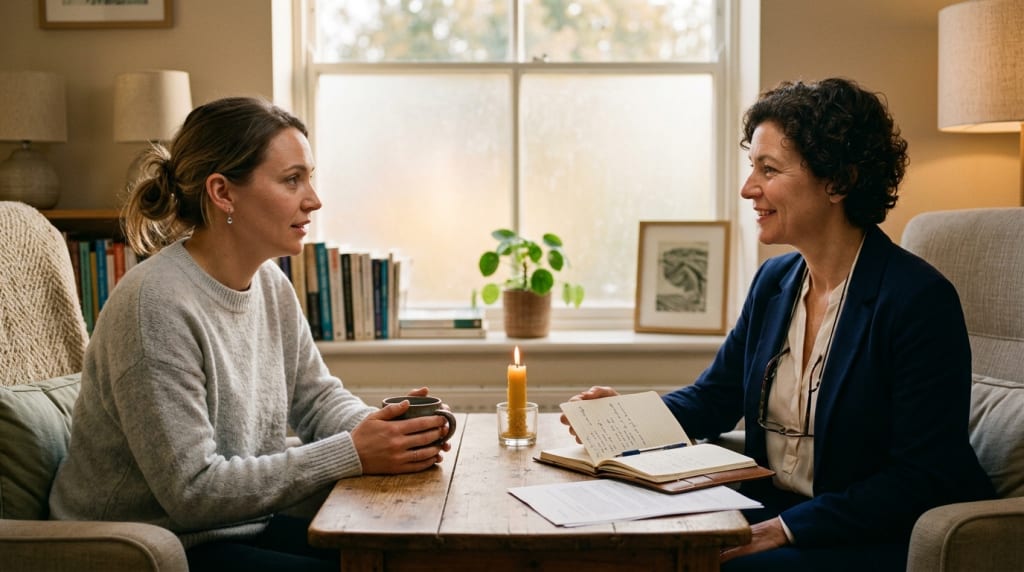
The mediator I spoke to was a woman in her fifties, straightforward and warm without being soft. She asked me about our situation without being intrusive, and she listened in a way I hadn't felt listened to in months. She explained what happens in a MIAM, that it wasn't just a tick-box exercise. It was a chance to understand what mediation could actually do, and whether it might be a better fit for us than going through the courts.
She asked me what I was most worried about. I said the children. I said I didn't want them to spend the next year watching their parents fight through lawyers. She nodded and said, "That's what most people say. And it's a very good reason to see if this can work."
Dan was resistant at first. He thought mediation was something I was pushing because I thought it would go in my favour. It took a few weeks and another conversation with a mutual friend before he agreed to come to his own MIAM. Once he had that meeting himself, something shifted. He rang me afterwards, which surprised me, and said he thought we should give it a go.
We had four mediation sessions over about two months. They weren't easy. There were moments in the second session when I had to stop myself from crying, not from sadness exactly, but from frustration, the feeling that we were going round in circles and that he still didn't understand why I needed more security around the finances. The mediator was patient in a way I found almost annoying at the time, though I'm grateful for it now. She didn't take sides. She kept bringing us back to what we both said mattered most, which was the children, and the life they'd have after all this was over.
By the fourth session we had a plan. Not perfect, nothing is, but workable. We agreed on how we'd handle the house, and we put together a parenting arrangement that gave both of us proper time with Freya and Oscar and built in enough flexibility for when things came up. Dan comes to all the football matches, for the record. Freya has decided Christmas is fine, actually better in some ways because she gets two.
I think about where we'd be if I'd gone straight down the court route. I think about the money, yes, but more than that, I think about the months of conflict, the things that would have been said and couldn't be unsaid, the effect on the kids. I went into the MIAM thinking it was a box to tick on the way to a courtroom, and I came out of it wondering why nobody had told me about it sooner.
Nobody talks about mediation in the way they talk about solicitors and court dates. It doesn't feel official enough, maybe. It doesn't feel like the proper, serious response to a serious situation. But it was exactly what we needed, and I think a lot of people end up in courtrooms they didn't need to be in, spending money they didn't need to spend, simply because they didn't know there was another way.
I wasn't a special case. Our situation wasn't unusually amicable or unusually straightforward. We were two people who loved our children and were struggling to talk to each other. The MIAM gave us somewhere to start. The rest followed from that.
Oscar still asks if I'm okay sometimes, in the evenings, when he's supposed to be asleep. He appears at the top of the stairs with his duvet wrapped round him like a cape. I tell him I'm fine, that everything is fine, and I mean it more than I used to.
This story is based on real mediation experiences, with details changed to protect confidentiality.
About the Creator
Jess Knauf
Jess Knauf is the Director of Client Strategy at Mediate UK and Co-founder of Family Law Service. She shares real stories from clients to help separating couples across the UK.
Jess is author of The Divorce Guide in England & Wales 2016.
Keep reading
More stories from Jess Knauf and writers in Families and other communities.
A Dad Who Didn’t Know How to Handle the Grief of Divorce
The first morning I woke up alone in the flat, I made two cups of tea. Force of habit. I stood there in the kitchen holding both mugs, one in each hand, and just stared at them like an idiot. Then I poured one down the sink and watched it swirl away.
By Jess Knauf13 days ago in Families
The Shadow in the Screen: Why Your Child’s Identity is the New Gold for AI Hackers
I remember the first time I saw it. A photo of my niece, the one I had taken at her fifth birthday party, appearing on a profile that didn’t belong to anyone in our family. The name was different. The location was halfway across the world. But the smile was unmistakably hers.
By Alex Sterling 7 days ago in Families




Comments
There are no comments for this story
Be the first to respond and start the conversation.