
City of plague:A new Yorker’s pandemic chronicle Pt 13.
The Distance We Could Not Keep
When the COVID-19 pandemic descended with merciless speed, the Centers for Disease Control and Prevention—known to most of us simply as the CDC—finally released its first official public guidance. Citizens were instructed to wash their hands frequently, using soap and water for at least twenty seconds. Not a casual rinse, but a deliberate ritual: palms rubbing palms, fingers interlaced, nails scrubbed, the narrow spaces between fingers carefully cleansed. Foam, they emphasized, was essential. Soap bubbles could penetrate and disrupt the virus’s fragile outer layer, rendering it inactive and stripping it of its ability to infect.
We were also told to maintain six feet of distance from others in public. Cough into your hand or elbow. Cover your mouth and nose. Prevent droplets from escaping. Protect yourself. Protect others.
These instructions, simple as they sounded, carried the weight of invisible terror.
I began washing my hands obsessively, almost to the point of neurosis. I washed them after touching anything—door handles, elevator buttons, my phone, even my own jacket. Yet I did not fully understand why the ritual had to last twenty seconds. I was not a medical professional. Much of the science behind it remained beyond me. In some strange way, ignorance provided a fragile comfort. Not knowing spared me from the full burden of fear. But ignorance could not protect the body. The virus did not care whether you understood it. It did not negotiate with the uninformed.
And so I tried to learn—not everything, but enough.
Whenever I went out, I avoided public restrooms entirely. The toilets in New York were low, and flushing often caused droplets to scatter into the air. I had read that the virus could be present in bodily waste. The possibility of infection through invisible particles haunted me. Door handles, faucets, metal surfaces—each became a potential threat. The mere thought of touching them made my skin crawl.
Even at home, I sometimes caught myself slipping. I would wash my hands quickly, dry them with a paper towel, and then suddenly freeze. Had I used soap? Had I washed long enough? Panic would rise inside me. I would turn back to the sink and begin again, this time counting silently, forcing myself to reach twenty seconds. Only then could I breathe again.
Experts warned that without soap, the virus could remain active, traveling down drains, surviving in hidden places. The thought lingered in my mind like a ghost.
Yet slowly, as washing my hands became second nature, my fear loosened its grip. Ritual brought comfort. Familiarity brought control. My nerves, once stretched tight as wire, relaxed slightly.
Covering my mouth when coughing or sneezing required less effort. It was a habit instilled in childhood, a lesson from elementary school teachers who taught us manners long before we understood disease. Now, with a mask covering my face, the gesture felt almost redundant.
Spitting in public, once an unpleasant but common sight, had vanished. No one dared. In those days, every act carried moral weight. Personal hygiene was no longer merely private—it had become a public responsibility. Each of us carried the invisible burden of protecting others.
But maintaining six feet of distance—that was another matter entirely.
It sounded simple. In practice, it was often impossible.
Before the pandemic, I worked long hours simply to survive, to support my family. When the city issued stay-at-home orders, many businesses closed. But my job was classified as essential. I could not stay home indefinitely. I worked fewer days—three per week—but I still had to leave my apartment, still had to enter the world.
And to do so, I relied on the subway.
The subway was my lifeline.
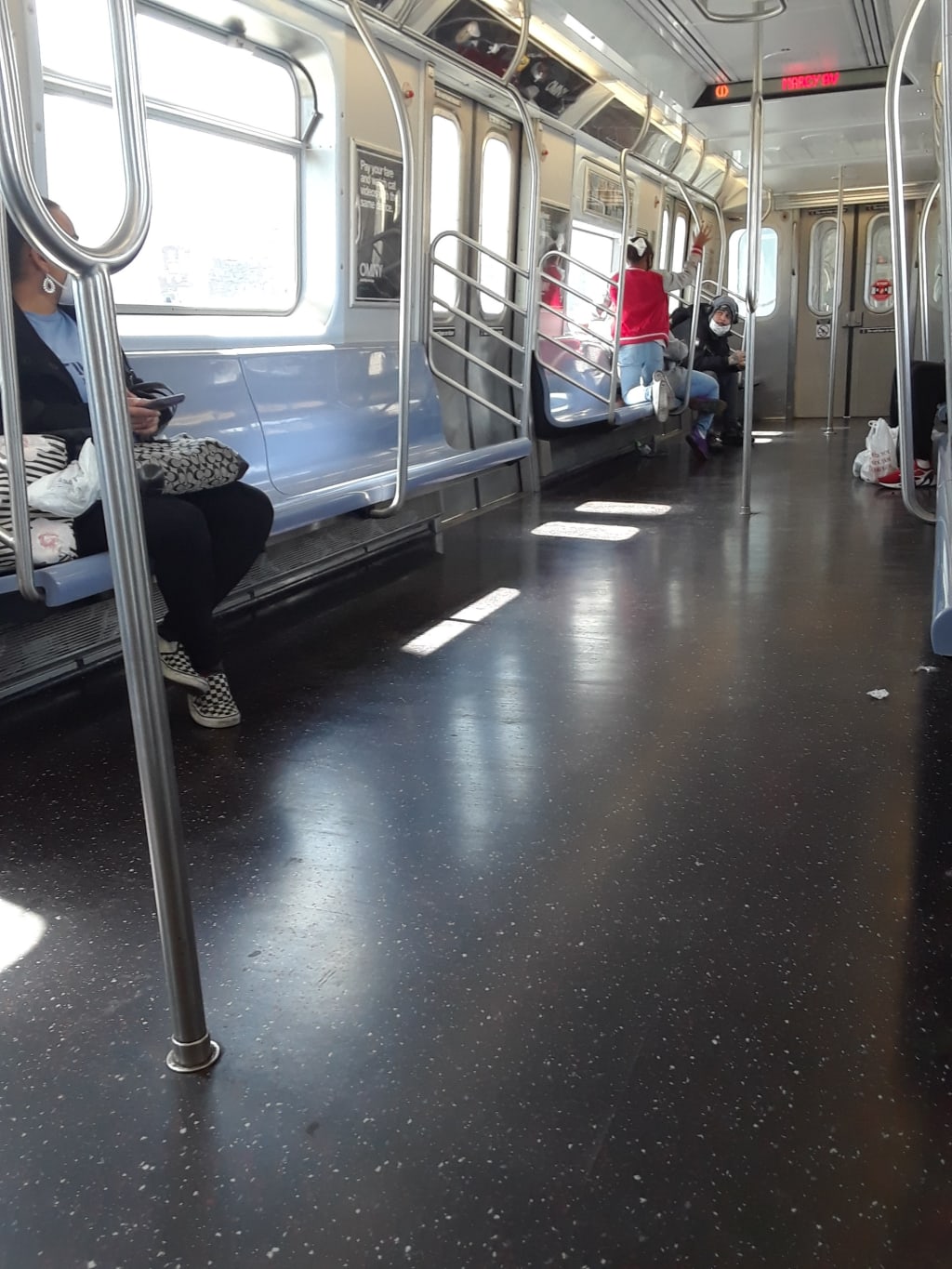
During the height of the pandemic, ridership dropped dramatically. The once crowded trains now carried only scattered passengers. The transit authority adjusted quickly, reducing service. Trains that once ran every ten minutes now came every twenty.
Standing alone on the platform, waiting, I became acutely aware of time. Minutes stretched endlessly. Every second felt exposed, vulnerable.
But I did not complain. Many subway workers had already fallen ill. Some had died. Others stayed home in isolation. There were not enough employees to maintain normal operations.
Under those circumstances, the fact that trains still ran at all felt like a blessing.
One morning, I arrived at the station as usual. I swiped my MetroCard at the turnstile.
Rejected.
I frowned and swiped again.
Rejected.
For a moment, I thought the machine was broken. It happened often enough. But when I looked more closely at the small display, the truth revealed itself.
Insufficient balance.
Embarrassment flushed through me.
Instinctively, I raised my hand toward my forehead, ready to slap it in frustration. But halfway through the motion, I stopped.
My hand hovered in the air.
I could not touch my face.
Not now.
Not ever, it seemed.
Slowly, I lowered my hand, defeated by an invisible enemy.
I walked to the ticket booth. The clerk sat behind the glass. I pulled out cash and my MetroCard, preparing to slide them through the small opening.
But the opening was closed.
Sealed.
I stared at it, confused.
“Why is the window closed?” I asked, unable to hide my irritation.
The clerk did not answer directly. She pointed instead to the nearby vending machine.
“You can refill your card there.”
Her voice was flat, distant.
I felt anger rising.
She had always sold tickets before. Why refuse now?
“I don’t know how to use the machine,” I said. “And there’s already a line. We can’t keep six feet apart.”
She did not look at me again.
“You can wait there.”
That was all.
I had no choice. I joined the line.
It did not move.
After several minutes, I leaned forward to see what was wrong.
The machine was broken.
The man at the front pressed buttons repeatedly, but nothing happened.
A low rumble filled the air.
A train was approaching.
We looked at each other, panic spreading among us.
“Miss!” someone shouted toward the booth. “The machine is broken! What do we do?”
The clerk said nothing.
She simply reached over and pressed a button.
With a sharp click, the emergency exit door unlocked.
We understood immediately.
No words were necessary.
She was letting us through.
One by one, we slipped through the emergency gate and hurried toward the platform, our footsteps echoing in the hollow station.
I boarded the train, breathless.
And ashamed.
For the first time in my life, I rode the subway without paying.
Not by choice, but by circumstance.
At my destination, I made sure to refill my card. I would need it later to return home.
Again, the ticket booth window remained closed.
“Please use the machine,” the clerk said.
This time, I obeyed.
After waiting ten minutes, it was finally my turn. To my surprise, the machine worked quickly. Within seconds, the transaction was complete.
Faster than any human clerk.
I was about to leave when a voice behind me spoke in Chinese.
“Excuse me… can you help me refill my card?”
I turned.
A woman stood behind me.
She was dressed neatly, stylish even. But beneath her appearance lay tension. Her eyes revealed exhaustion.
She stood too close.
Far too close.
We were not six feet apart.
Fear surged through me.
But she wore protection—hat, glasses, mask, gloves. Just like me.
We had both armored ourselves against an invisible war.
If infection could occur so easily, it might have already happened. Fear, at this point, was useless.
In that moment, something shifted inside me.
We were strangers.
Yet we shared the same vulnerability.
The same exile.
The same quiet desperation.
“How much?” I asked.
“Twenty dollars,” she said softly.
I took her card and completed the transaction in seconds.
When I returned it to her, she said, “Thank you.”
Her voice trembled slightly.
I could not see her face, but I heard everything she could not say.
Gratitude.
Fatigue.
Loneliness.
That night, I searched online and discovered the truth.
More than one hundred subway workers in New York had died from the virus.
The number stunned me.
Terrified me.
And suddenly, I understood.
The closed ticket window.
The silent clerk.
The distance.
She had not refused to help us out of indifference.
She had done it to survive.
Six feet.
Such a small distance.
And yet, it separated fear from safety.
Life from death.
Human beings from one another.
That night, I lay in bed, unable to sleep.
I turned from side to side, listening to the silence.
Six feet.
It was not just a measurement.
It was the distance between strangers.
The distance between compassion and fear.
The distance between who we were…
and who we were becoming.
About the Creator
Peter
Hello, these collection of articles and passages are about weight loss and dieting tips. Hope you will enjoy these collections of dieting and weight loss articles and tips! Have fun reading!!! Thank you.
Real men drink, right?
He has a problem. He’s felt it for years now, but he refuses to face it. He doesn’t want to admit it, to himself or to the people around him. All his heroes were the same. He likes to recall the scene where James Bond sits in a dusty pub in Latin America, a glass of whiskey in hand, his gaze fixed on a scorpion crawling across the bar. When he first fell for literature, it was Post Office and Women, which he read over and over again. Without those cans of beer and bottles of cheap whiskey, Bukowski’s work wouldn’t have been so raw, so honest. Even Vaclav Havel spent most of his nights in Prague bars; without that, he wouldn’t have been who he was. Those were the real men.
By George Roast7 days ago in Fiction
Microsoft's Purposeful Marketing Deception About AI's Ability To Beat Physicians In Diagnosis
When you look at the world of scientific research... If you are not careful... You will be fooled into believing things that are not actually supported by the data.
By Dr. Cody Dakota Wooten, DFM, DHM, DAS (hc)a day ago in Longevity



Comments
There are no comments for this story
Be the first to respond and start the conversation.