
Fire in the Dark
How the First Story Was Born

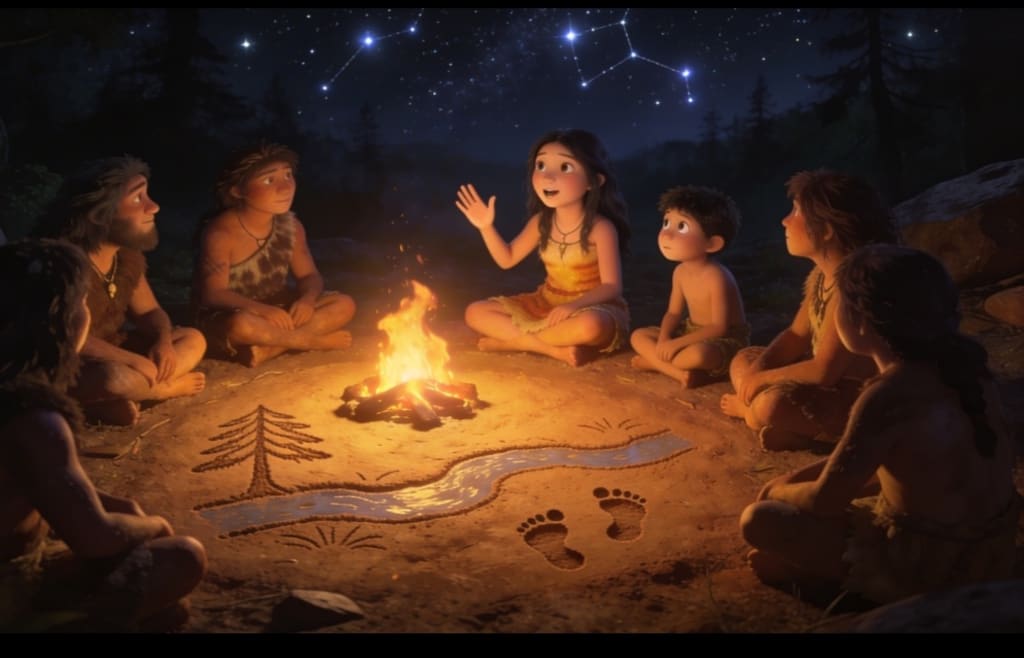
Storytelling began before there was even a word for “story.”
Back when the world was still lit by fire and fear, people lived in small circles of light. The nights were longer than they are now, or at least they felt that way. Wind crept through branches like whispers, animals called to each other in voices humans did not yet understand, and the darkness beyond the fire was full of questions.
In one of those circles of light sat a child named Ara. Ara’s people knew how to hunt and gather, how to set traps and find water, how to watch the sky and the seasons. But they did not yet know how to hold a memory together. Moments slipped away like smoke. The faces of the day—deer, river, storm—came and went, and each new sunrise felt like a beginning with no thread to tie it to what came before.
One cold night, the fire burned lower than usual. The hunters were late returning, and worry moved through the circle like a chill. Ara’s younger brother, Tanu, clung to her arm.
“Will they come back?” he whispered.
Ara wanted to say yes, but the word felt thin, like dry grass. So instead, she looked into the heart of the fire. The embers glowed red and gold, and in them she saw the day replaying itself: the hunters leaving, the river shining, the trail disappearing into trees.
“Look,” she said softly, pointing at the flames. “Do you see it?”
Tanu frowned. “See what?”
“The day,” Ara said. “The hunters walked into the trees. The trees swallowed them like a big dark mouth. But before that, the sun touched the river and turned it to gold. The river is still there. The trees are still there. They know the hunters’ feet. They will show them the way home.”
As she spoke, the others drew closer, their faces gathering around the fire like stones circling a flame. Ara had never spoken this way before. She did not know where the words were coming from, only that they felt like stepping-stones over a deep river of fear.
She lifted a burning stick and drew its embered tip across the ground, tracing lines and shapes: tall lines for trees, wavy lines for the river, small marks for the hunters’ footsteps.
“This is what happened,” she said. “This is how the day walked.”
The oldest woman in the circle, who remembered more winters than anyone, watched Ara carefully. “You are catching the past,” the elder murmured. “You are trapping it in sound and shape.”
Ara felt her face grow warm, but Tanu leaned closer, his eyes wide.
“What about the sky?” he asked. “Did it watch them too?”
Ara paused. She looked up at the stars, scattered and bright, then back at the stick in her hand.
“The sky,” she said slowly, “placed lights above them, small fires that cannot go out. One light for each hunter. The sky is guiding them, even now.”
A hush fell. Around the fire, the people could almost see it: the hunters moving through the dark, with star-fires above, a river of silver, trees breathing quietly around them.
For the first time, the waiting did not feel empty. It felt like part of something bigger, a path inside a story that had not yet reached its end.
The elder touched Ara’s shoulder. “Say it again,” she requested. “From the beginning.”
So Ara did. But this time, as she spoke, she shaped the moments with more care. She gave the trees voices that hushed when danger was near. She gave the river a memory of every foot that had crossed it. She made the sky not just a watcher, but a companion that blinked and glittered with concern.
With each telling, the listeners shifted. Fear loosened its grip on their chests. Worry became a question instead of a cage: What will happen next?
Hours passed. The night grew colder. But near the end of the long waiting, just when people were wrapping themselves in silence again, a shout came from the dark.
The hunters were returning.
They emerged from the trees, shoulders heavy, feet tired, but alive. The circle broke into laughter and tears. Children ran forward, then back again, unsure if they were allowed to touch miracles.
As they ate and warmed themselves, the hunters spoke of their journey: how they had lost the path, how the river’s sound led them back, how they watched the stars to be sure they were going the right way.
Ara listened, stunned. They were saying her story. Not word for word, but close enough that her skin prickled.
Later, when bellies were full and the night softened again, the elder raised a hand.
“Tell it,” the elder said to Ara. “Tell how they left and how they returned. Let the little ones hear, and let us keep this night.”
So Ara told it. This time she wove the hunters’ own words into the fire-lit tale. She showed how the river sang to them, how the stars guided them, how fear followed but did not win. She showed how courage is not the absence of fear, but walking through the dark anyway.
When she finished, the elder nodded. “This,” the elder said, “is stronger than fire.”
“Stronger than fire?” Tanu asked, puzzled.
“Fire warms us for a night,” the elder replied. “But these word-fires you make can warm us again and again. When we are afraid, when we forget, we can ask for the night you carry in your mouth and hands. And you will bring it back.”
The people did not yet have a word for what Ara had done. They only knew that they felt different. The children slept more easily. The adults looked at the world with eyes that could now see not only what was, but what had been and what might be.
In the days that followed, others tried to do what Ara had done.
One hunter told the story of the time he faced a great beast and lived, shaping his terror into lessons about tracks and wind and patience.
A gatherer told the story of a dry season, how hunger taught them which roots hid deep water.
A mother told the story of a child born during a storm, and how the lightning seemed to bow in greeting.
Their hands drew in the dirt, on stones, on cave walls: spirals for the sun, lines for rivers, stick figures chased by animals, dots like stars. The pictures held the bones of their memories; the spoken words gave them breath and movement.
Soon, nights were no longer just for sleeping or fearing the dark. They became places where people met the past and rearranged it into meaning. Children learned not only where to find food, but why their people moved with the seasons, why they honoured certain animals, why they gathered under certain trees.
One evening, a traveller from another group visited their fire. He listened as Ara spoke, then laughed in surprise.
“We do this too,” he said. “By the big rock that looks like a sleeping bear, an old man tells us how the stars fell into the river and became fish. We sit and listen, and when we hunt, we remember.”
Ara’s people stared at him. “You have these word-fires as well?” the elder asked.
The traveller nodded. “We thought we were the only ones.”
Under that shared sky, they understood something quietly powerful: wherever people gathered, fear and questions gathered too. And where fear and questions gathered, someone began to speak. To connect the small pieces of life into something that felt like a path.
They still didn’t have a single name for it. Some called it “remembering aloud.” Some called it “the long thread.” Others simply called it “the sitting,” because you had to sit still long enough to let the pictures form in your mind.
Much later—so much later that Ara and Tanu and the elder were memories inside other people’s voices—someone would finally give it a name.
They would call it storytelling.
But storytelling was older than the name. It began the first time a human thought, “I am afraid,” and another human answered, “Listen.”
It began the first time a child asked, “Where did we come from?” and an elder picked up a stick, pointed at the sky, and began to draw.
It began the first time a night felt too long, and someone dared to light a second fire—not in wood, but in words.
And even now, every time you sit down to tell what happened, or imagine what might have been, every time you turn a memory into a path someone else can walk, you are standing in Ara’s circle of light, adding your voice to the very first story that humans ever told: the story of how we learned to make meaning out of the dark.
About the Creator
Oluremi Adeoye
Accomplished writer & former journalist. I craft engaging articles for Vocal media, exploring diverse topics with passion and depth, creating compelling narratives that resonate with readers.
Keep reading
More stories from Oluremi Adeoye and writers in Fiction and other communities.
The Feather That Fell Back
They say he flew away with wings of cleverness and wax, leaving Crete behind like a cage he finally outsmarted. They say his mind was unmatched—that Daedalus was born to rise above men, to carve the air itself into a pathway of freedom.
By Oluremi Adeoye 13 days ago in Fiction
The Solitude of The Chupacabra
Many say that the Chupacabra is a rather recent and modern tale, a mangy coyote or rabied dog. Some point out that it’s just twisted evolution. But very few know the true backstory of the shapeshifter that led to the bloodsucking legend. And perhaps once you will come to know and understand more, you might “forget” a few cattle out to wander.
By Oneg In The Arctic6 days ago in Fiction
Beginner's Luck: Liminal 4
Fluke's eyes widened at the new stat: Resonance: 1.9 He had no idea what it could mean but he felt excited to try it out. Sitting up on the bed, he began to try and focus his energy like he had done in his dreams. Letting out a long slow breath, he focused on the sensation in his right index finger. His mind instantly began to feel the slight buzzing energy that was normal for any part of his body. Slowly, he felt that energetic buzz building up and concentrate down in the pad of his finger. The energy began to go beyond just a vibration, now turning to heat, which made Fluke almost panic. Concentrating again, he began to spread his focus to the rest of his hand, the heat now expanding with the electrical energy. Letting the energy swirl in the palm of his hand, Fluke opened his eyes to see if he could visualize what was happening. But sadly, there was nothing to visualize at first. An icon appeared in his masks vision; it was just a simple eyeball symbol. Trying not to break his concentration, he focused for a moment on the symbol and suddenly it was as if he could see so much more of the world.
By Everett Scaife6 days ago in Fiction


Comments
There are no comments for this story
Be the first to respond and start the conversation.