
THE CORNER HOUSE
Some rules live in the silence between neighbors

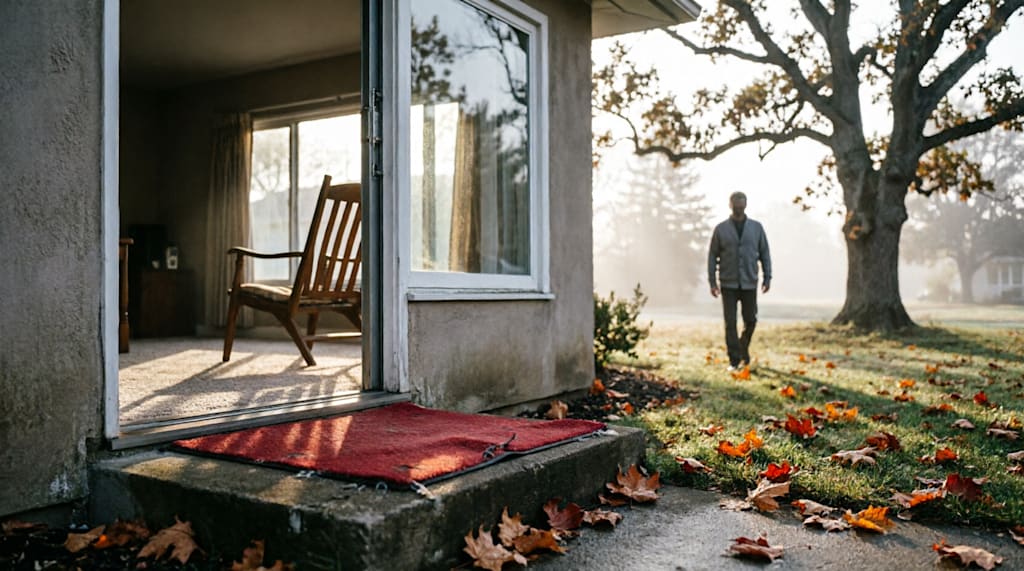
The mail carrier never walked up the path.
She'd pause at the edge of the sidewalk, toes aligned with the crack where concrete met grass, and slip the envelopes through the slot with a practiced flick of her wrist. Sometimes they caught. Sometimes they fluttered to the welcome mat, which had faded from red to something closer to rust. She never went to retrieve them.
The children knew better than to chase balls that rolled into the Harlow yard. They'd watch, breath held, as the white sphere came to rest against the porch steps, and then turn away, calling new games in opposite directions.
Once, a new boy—seven years old, from Phoenix, didn't know yet—ran after a stray kick. His mother's hand shot out like a strike, catching his collar before his foot touched the first step. She didn't scold. She didn't need to. The look she gave him said everything: We don't.
The grocery store delivered to the side door. Not the front, never the front. The driver, Marcus, had been making these runs for eleven years. He knew to leave the bags in the exact spot on the concrete, to ring the bell once, to walk away without waiting.
Payment appeared in the mailbox three days later, cash in an envelope with no name. He never counted it. He never looked at the windows.
At the annual block party, held every August in the cul-de-sac where grills smoked and music drifted, one paper plate sat empty at the end of the long folding table. No one filled it. No one sat in the chair beside it. Children learned early to stack their napkins there, used and crumpled, like an offering.
Mrs. Harlow herself was seen perhaps once a month. She'd emerge at dawn, always in the same gray cardigan, always carrying a small basket. She walked to the corner where the old oak dropped its acorns and gathered what had fallen overnight.
Neighbors watching from behind curtains would note the time, the weather, whether she seemed slower than before. Then they'd close the blinds and make coffee and not speak of it.
The real estate signs never stayed up long.
A young couple tried it first, three years ago. Bright-eyed, they planted their SOLD banner in the front lawn and spent a weekend painting the trim. They hung wind chimes. They ordered a new welcome mat. On Monday morning, the chimes were gone. The mat had been folded neatly and placed beside the trash cans. The sign lay face-down in the grass, stakes bent.
They lasted six months.
The next family brought a dog. A golden retriever named Sunny, according to the tag on its collar. Sunny barked at squirrels, at mail trucks, at the silence that seemed thicker on that block than anywhere else in the city. The dog disappeared on a Tuesday. The family left on Friday. No moving trucks. Just gone.
People stopped trying after that.
I moved in during October, when the air smelled of burning leaves and the light came early. I didn't know the rules. No one had told me.
I was twenty-three, fresh out of graduate school, carrying boxes of books and a naive belief that neighborhoods were made of people who wanted to know each other. I baked cookies. I wrote my number on little cards. I walked up the Harlow path on my third evening, the one with the basket of still-warm chocolate chip, and knocked three times.
The sound echoed differently than it should have. Too hollow. Too final.
Mrs. Harlow opened the door maybe two inches. I could see one eye, pale blue, rimmed with red. She didn't look at the cookies. She looked past me, down the street, where I could feel other eyes behind other curtains.
"You shouldn't," she said. Her voice was thin, like paper about to tear.
"I just wanted to welcome you to the neighborhood," I said, and even then, something in me knew I had it backwards.
She closed the door. Not slammed. Not rude. Just closed, the way you close a book you've finished reading.
The next morning, my cookies were in my own trash can, the basket washed and dried and placed beside them. No note. None was needed.
Winter came hard that year. Snow piled against the Harlow windows, and I found myself watching for the gray cardigan, for any sign of movement. There was none. The mail kept coming. The groceries kept appearing at the side door. The empty plate waited at the block party planning meeting, though it was months away.
My mother called from Ohio. "How's the new place?"
"Good. Quiet."
"Neighbors friendly?"
I thought of the curtains twitching as I took out my recycling. I thought of the way people crossed the street to avoid walking past the corner lot. I thought of Mrs. Harlow's eye, pale and tired and holding something I couldn't name.
"They're... respectful," I said.
"That's nice, honey."
In March, the first crocus pushed through the snow near the Harlow porch. I noticed because I was watching. I couldn't help it. There's something about silence that makes you lean in, that makes you search for the shape of what's missing.
A woman named Diane lived three doors down. She'd been on the block for twenty-two years. We met at the mailbox one morning, both reaching for our letters at the same moment. She was older than me, maybe fifty, with silver threading through dark hair and hands that moved constantly, folding and unfolding the envelope she held.
"You're the one who knocked," she said. Not a question.
I felt heat rise in my cheeks. "I didn't know."
"No one does. Not at first." She paused, looked at the Harlow house, looked away. "My husband and I moved here in '98. There were five families on this block then. The Harlows had just bought the corner. David taught math at the high school. Eleanor—Mrs. Harlow—she volunteered at the library. They had a boy. Seven years old."
She stopped. I waited. She didn't continue.
"What happened?" I asked, and immediately knew I'd crossed something.
Diane's hands went still. She looked at me the way you look at someone who's just stepped into traffic without checking.
"We don't," she said.
Then she walked away, and I stood at the mailbox with my unopened letters and understood, finally, what I'd been missing.
The rule wasn't written anywhere. It wasn't discussed at HOA meetings or printed in the welcome packet for new residents. It lived in the space between words, in the pauses before answers, in the careful architecture of avoidance that everyone had learned to navigate without thinking.
We don't ask.
We don't stare.
We don't knock.
We don't try to fix what can't be fixed.
We honor it by leaving space. By letting silence be silence. By understanding that some grief is not a problem to be solved but a weather pattern to be endured, and the best thing you can do is learn to carry an umbrella.
Spring turned to summer. The block party came and went. I sat at the long table and watched the empty plate accumulate napkins, candy wrappers, the detritus of celebration. No one explained it. No one needed to.
Mrs. Harlow appeared at the edge of the gathering once, just after dusk, standing in the shadow of her own porch. She didn't come closer. We didn't invite her. Someone had left a plate at the end of the table earlier, filled now with food that would go uneaten. She saw it. She nodded, almost imperceptibly. Then she went inside.
Marcus the delivery driver told me later that he'd seen her in the window sometimes, sitting in the same chair, looking out at the yard where a swing set had once stood. He didn't know how long it had been there. No one did. We just knew it wasn't there anymore, and we knew not to ask why.
I've lived on this block for four years now. I know when to pause at the sidewalk. I know which door to approach. I know that the empty chair at the table isn't really empty—it's full of everything we don't say, and that's its own kind of presence.
Last week, a new family moved in across the street. Young. Loud. They hung wind chimes. They ordered a welcome mat. Their six-year-old daughter kicked a soccer ball into the Harlow yard on her second day.
I watched from my porch as her mother's hand shot out, catching the girl's shirt before she could run after it. I watched the mother's face change as she understood, as she absorbed the weight of a rule she hadn't known she was stepping into.
She looked up. She saw me watching. I gave a small nod, the kind that says you'll learn, and you'll be okay, and we all carry this together.
She nodded back.
That evening, I baked cookies. I put them in the washed basket. I walked to the edge of the Harlow path and set them down, and I walked away without knocking.
The rule doesn't need to be spoken. It lives in the space between the knock and the door, in the pause before the question, in the plate that stays empty and the chair that stays full.
We don't ask. We don't fix. We don't look away, but we don't stare.
We bear witness.
And in the bearing, in the careful quiet of a neighborhood that has learned how to hold grief without crushing it, we become something like family. Not the kind that gathers for holidays or knows your middle name, but the kind that understands when silence is the only language left, and speaks it fluently.
The mail carrier still pauses at the crack in the sidewalk. The children still chase balls in other directions. The grocery bags still appear at the side door.
And Mrs. Harlow still walks to the oak tree at dawn, gray cardigan against gray sky, gathering what has fallen.
We let her.
We don't ask what she's collecting.
We don't need to.
About the Creator
Edward Smith
I can write on ANYTHING & EVERYTHING from fictional stories,Health,Relationship etc. Need my service, email [email protected] to YOUTUBE Channels https://tinyurl.com/3xy9a7w3 and my Relationship https://tinyurl.com/28kpen3k
Keep reading
More stories from Edward Smith and writers in Fiction and other communities.
The Weight of a Feather
The sun hadn't yet cleared the jagged teeth of the basalt cliffs when Elias began his morning ritual. He stood before the mirror, checking the leather harness that crisscrossed his chest. It was worn supple by decades of salt and sweat. He adjusted the buckles, ensuring the iron-grey stone fastened to his small of his back was centered. It was the size of a prize-winning pumpkin and weighed exactly eighty-four pounds.
By Edward Smithabout 8 hours ago in Fiction
The Midnight Letter
It was a rainy night when Clara sat by her old oak desk, staring at the pile of unopened letters that had accumulated over the past month. Her small apartment smelled faintly of coffee and rain-soaked streets, a combination that reminded her of long-forgotten days spent in her childhood home. There was something strangely comforting about the routine of going through letters, even if most of them were bills, advertisements, or notifications she didn’t particularly care about.
By Fawad Ahmad4 days ago in Fiction


Comments (1)
I love the message!