
Tomb Raider Retrospective - 4
Chapter 4: The Legend Era (2006 - 2008)

Angel of Darkness had been a sort of soft reboot of the series, but, as I noted before, it was a complete failure and Eidos Interactive took control of the IP and sent it to Crystal Dynamics. This left fans rather worried about what would happen next. Crystal Dynamics took over, as noted before, and work on the next adventure began.
2006 - Tomb Raider: Legend
Obviously, with a new studio at the helm, the fans were nervously awaiting Lara’s next adventure. Crystal Dynamics initially thought of picking up the story where Angel of Darkness had left off. Of course, that didn’t happen; they decided it was a bad idea to stick to the setup from Angel of Darkness. With that in mind, they knew they would have to do something major to reassure them. To that end, they brought in the one man that knew Lara better than anyone. They brought in Toby Gard.
Now, Gard had, as we mentioned before, left the Tomb Raider franchise pretty early on due to creative differences over the marketing of the character. After TR 1, Lara became a sort of sex symbol and that wasn’t something that he liked at the time. Still, he agreed to come on board.
"When I arrived here, I knew everyone was expecting something more modern, more up-to-date for the next game... I think that people kind of realized that they needed to have a clearer idea of how to use the character, and that's certainly something I can bring them... When I came in my goal was to shake things up a bit." - Toby Gard
Shake things up indeed, well done Mr. Gard, well done! Lara underwent a number of significant changes.
Initially, Lara had her signature braid, but that was changed and she got a ponytail instead. She also got some new moves and toys. Crouching, for instance, is back, but you can also roll, kick objects and have a slow-mo instant headshot. Switching weapons is also easier, just a single button press. We also get some new equipment including:
- PDA
- Flashlight
- Grappling hook
As the game’s development progressed, the fanbase began to speculate about who the new Lara Croft would be. It wasn’t long before it was announced that Keeley Hawes would be taking the role.
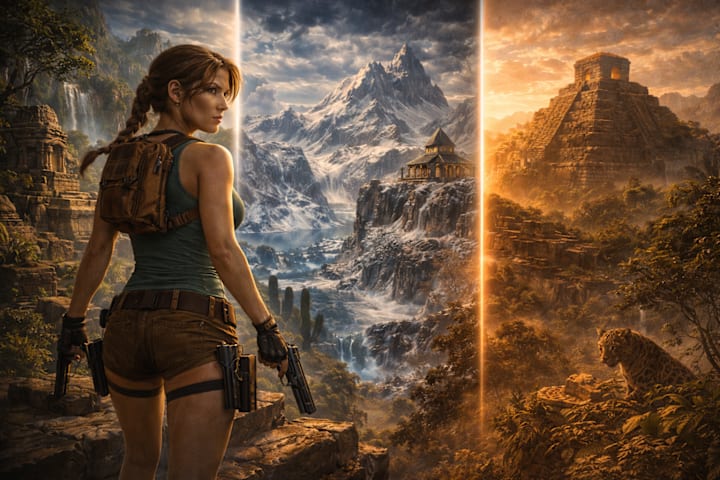
In addition to the changes to Lara’s look, her backstory was changed, and the controls were updated. The whole idea was to make a Tomb Raider game that anyone could just pick up and play. Now, admittedly, I didn’t find much on the actual development cycle of the game, but I did find a few interviews that discussed the game. I’ll discuss what I can, based on those interviews. I’ll also share some development-related observations - stuff I noticed while playing.
Developing Tomb Raider: Legend, the team at Crystal Dynamics started out by getting away from the series’ grid system. The original games worked around a grid system, every square was the same size. For Legend, they built a new engine to create an open environment in which Lara can navigate. They were determined to do the series justice.
“Basically, we wanted to do everything we did right.” - Eric Lindstrom
I think it’s safe to say they succeeded, wouldn’t you?
Tomb Raider: Legend was met with positive reviews. Critics called it a return to form with the story, music, and controls being praised. Criticism was levelled, however, at the combat system for being shallow - which I can sort of understand.
2007 - Tomb Raider: Anniversary
With Legend’s success, the team at Crystal Dynamics had officially revitalized the series and reassured fans that they knew what they were doing. It seemed that the franchise was in good hands. Of course, there was the possibility that Legend had been a fluke - just straight up sheer dumb luck. With that in mind, Crystal was determined to prove that Legend’s success was no fluke.
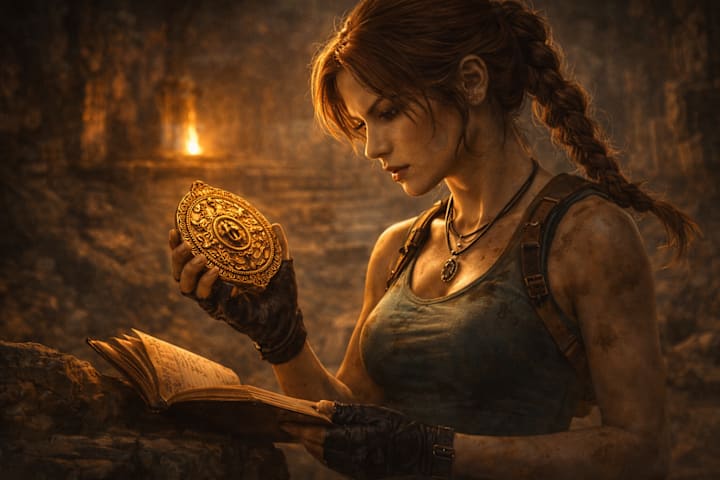
Crystal Dynamics started development of Anniversary a short while after Legend’s completion. They went back to the engine that they’d used for Legend to rebuild the levels from Tomb Raider I. The idea was to recreate the original game without making it derivative of itself. To that end, they made a few changes to the level designs, and added some truly devious traps. Spike pits, crushing doors and crumbling tiles and ledges are all back and better than ever.
The levels were more realistically designed with caves looking more like caves. The City of Vilcabamba actually looks like an ancient tribal city or village with buildings, bridges, and pottery shards really selling the illusion. Likewise, the Lost Valley has a proper sky this time with mountains in the background and everything so you don’t have this weird black texture where the sky should be.
As for Lara herself, she looks great. Much like with Legend, her outfits have actual texture to them - her shirt, for example, actually looks like fabric. Her trademark braid also makes a return, although, it’s much shorter and styled slightly differently from the original games. Sadly, the slow-mo headshot mechanic isn’t here anymore and neither is melee combat. In their place(s), however, is the adrenaline dodge which is somewhat similar. Basically, you shoot an enemy until their rage meter fills up and they become enraged. A quick combination of button presses, and you get a pretty cool variation of the head shot mechanic from the previous game.
However, it’s not perfect and you won’t nail it every time, but it’s oh so satisfying to pull off. The QTEs (quick time events, for the uninitiated) and scripted boss fights were, in retrospect, rather dull and uninteresting and the ragdoll animations that replaced the brutal death scenes do look rather silly.
2008 - Tomb Raider: Underworld
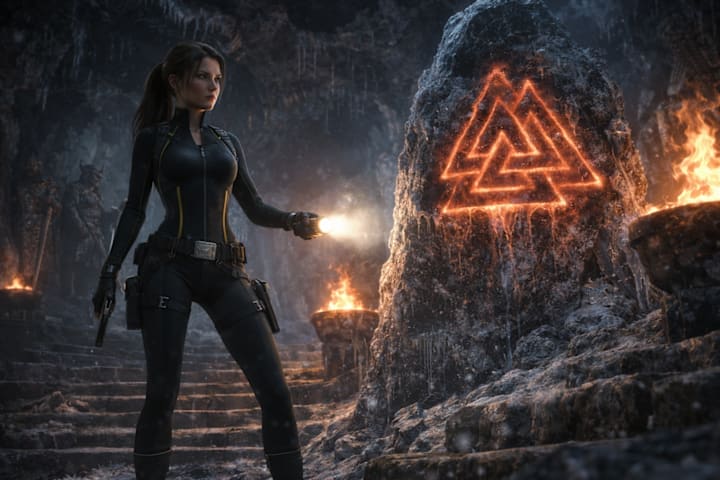
Underworld was Crystal Dynamics’ third Tomb Raider game and it was set to conclude Lara’s search for Avalon and her mother. Planning started all the way back when Legend was wrapping up in ‘06. The fan response was looking good, and the dev team figured they had enough conceptual material to work with so they started planning early. Of course, Tomb Raider: Anniversary was being done at the same time, so Underworld’s dev team was shorthanded.
The game’s story was written by Eric Lindstrom and Toby Gard. Gard was also credited as the game’s cinematic director; Underworld was the last game in the series to involve Lara’s co-creator - as far as I can find, at least. Mr. Gard left Crystal Dynamics in 2009, feeling that he’d had less influence over Lara Croft since his involvement with Legend.
Lindstrom and Gard worked together and decided to use Norse mythology as the central mythos for the storyline. With the mythology decided, the two men went to work aiming to make the game’s story short, and entertaining. As part of the game’s production, the team took trips to places like Mexico and Cambodia. The musical score was a collaborative effort this time around. Troels Brun Folmann worked on the main theme and then supervised composer Colin O’Malley’s work on the game’s soundtrack.
Tomb Raider: Underworld was released for PC, PS3, Xbox 360, the Nintendo Wii, and the Nintendo DS in 2008. Generally speaking, the game was well-received with the PC and console versions gaining high praise for the visuals, motion capture work, and gameplay. Criticism was leveled, however, at the camera work and combat system.
Despite the positive reception, however, Tomb Raider: Underworld ultimately failed to meet sales expectations with sales maxing out at 1.5 million units worldwide by December 31, 2008. Since then, the game seems to have gained quite the following because, as of September 2021, sales have ballooned to 3.8 million units…now, that’s cool!
About the Creator
Greg Seebregts
I'm a South African writer, blogger and English tutor; I've published 1 novel and am working on publishing a 2nd. I also write reviews on whatever interests me. I have a YouTube Channel as well where I review books, and manga and so on.
Keep reading
More stories from Greg Seebregts and writers in Gamers and other communities.
Knights of the Old Republic II
A long time ago, on a writing platform far, far away, I wrote a review for Knights of the Old Republic. It was part of my Star Wars content for May 2024. My final verdict on that one was that it was great fun. It wasn't perfect, but I had a great time playing it. Now, it's time to look at the sequel - yes, there's a sequel.
By Greg Seebregts21 days ago in Gamers
U4gm Bleed and Block: Mastering the Shield‑Wall Warrior in PoE 2
When I first tried the Bleed Shield‑Wall Warrior in Path of Exile 2, I wasn’t expecting to enjoy it as much as I did. I usually lean toward flashy, high-damage builds, but there is something incredibly satisfying about standing in the middle of a battlefield, surrounded by dozens of enemies, and not just surviving—but actively controlling the fight. This is exactly what the Bleed Shield‑Wall Warrior allows you to do.
By Dangyc Dingabout 8 hours ago in Gamers


Comments
There are no comments for this story
Be the first to respond and start the conversation.