
How Saladin Conquered Jerusalem
The remarkable journey of a Kurdish commander who rose from serving a Shiite caliphate to becoming the legendary hero of the Crusades

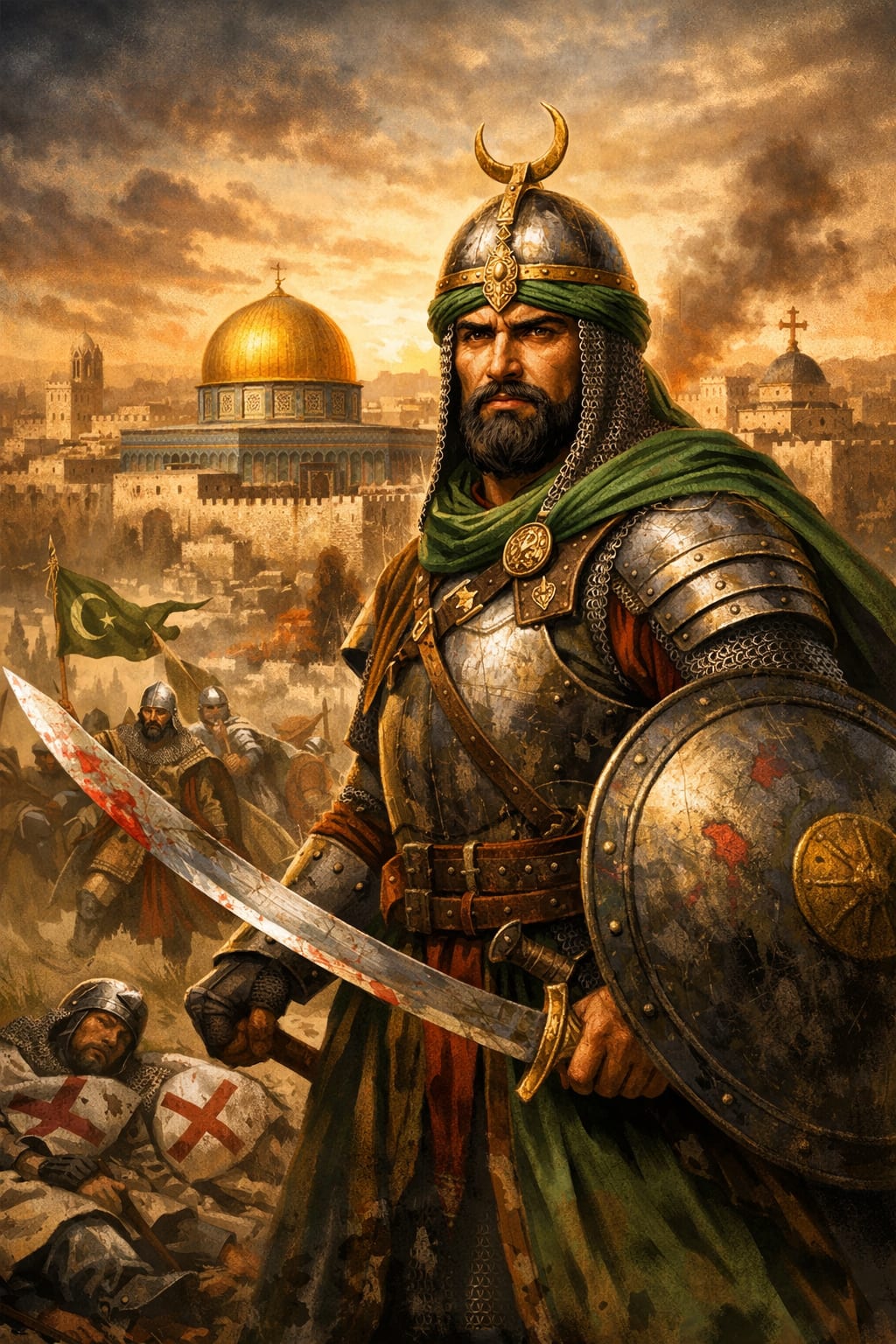
The story of Saladin is one of the most compelling narratives in medieval history—a tale of strategy, faith, and political brilliance. Known in the Muslim world as Salah ad-Din, he rose from relatively modest beginnings to become the man who recaptured Jerusalem from the Crusaders in 1187, reshaping the balance of power in the Near East.
Saladin was born in 1137 or 1138 in Tikrit, in present-day Iraq, into a Kurdish family. His early life did not immediately suggest that he would become a great military leader. Instead, his rise began under the patronage of his uncle, Shirkuh, a general serving the powerful Muslim ruler Nur ad-Din. At the time, the Muslim world was politically fragmented, with rival dynasties competing for influence, while the Crusaders controlled key territories, including Jerusalem.
Saladin’s turning point came when he accompanied Shirkuh on military expeditions to Egypt, then ruled by the weakening Fatimid Caliphate. After Shirkuh’s death in 1169, Saladin was unexpectedly appointed vizier (chief minister) of the Fatimid state. This was a remarkable development: a Sunni Muslim now held a powerful position in a Shiite regime.
As vizier, Saladin demonstrated not only administrative skill but also political foresight. He gradually consolidated his power, reformed the military, and strengthened Egypt’s economy. In 1171, he made a bold and decisive move: he abolished the Fatimid Caliphate and restored allegiance to the Sunni Abbasid Caliphate. This act unified Egypt under Sunni rule and effectively ended two centuries of Fatimid dominance.
Following the death of Nur ad-Din in 1174, Saladin expanded his control beyond Egypt into Syria. Through a combination of diplomacy and military action, he unified much of the Muslim Near East under his leadership. This unity was crucial, as one of the main reasons for earlier Muslim defeats during the Crusades had been internal division.
Saladin understood that reclaiming Jerusalem required more than just military strength—it demanded strategic patience. For years, he avoided direct confrontation with the Crusader states, instead focusing on consolidating power and weakening his enemies economically and politically. His opportunity came in 1187, after repeated provocations by Crusader forces, particularly the reckless actions of Raynald of Châtillon, who attacked Muslim caravans and violated truces.
In response, Saladin launched a full-scale campaign against the Crusader Kingdom of Jerusalem. The decisive moment came at the Battle of Hattin. There, Saladin’s forces encircled and defeated the Crusader army, capturing key leaders, including King Guy of Lusignan. The victory shattered Crusader military power in the region.
With the Crusader defenses weakened, Saladin advanced toward Jerusalem. The city, which had been under Crusader control since 1099, was heavily symbolic for both Muslims and Christians. After a brief siege, Jerusalem surrendered to Saladin on October 2, 1187.
What followed distinguished Saladin from many conquerors of his time. Unlike the brutal massacre carried out by Crusaders when they captured the city decades earlier, Saladin showed remarkable mercy. He allowed Christian inhabitants to ransom themselves and leave safely, and he protected holy sites. His conduct earned him respect even among his enemies and cemented his reputation as a chivalrous and just leader.
The fall of Jerusalem shocked Europe and triggered the Third Crusade, led by figures such as Richard the Lionheart. Although Richard achieved some military successes, he failed to retake Jerusalem. Saladin maintained control of the city, while negotiations eventually allowed Christian pilgrims access to holy sites.
Saladin’s legacy extends far beyond his military achievements. He is remembered as a unifier of the Muslim world, a skilled السياسي (statesman), and a model of اخلاق (ethics) in warfare. His ability to rise from a provincial officer to the ruler of a vast empire—and ultimately the liberator of Jerusalem—makes his life one of history’s most inspiring journeys.
In the end, Saladin did not just win battles; he changed the course of history, proving that leadership grounded in vision, unity, and restraint can leave a lasting mark on the world.
About the Creator
Irshad Abbasi
Ali ibn Abi Talib (RA) said 📚
“Knowledge is better than wealth, because knowledge protects you, while you have to protect wealth.
Keep reading
More stories from Irshad Abbasi and writers in History and other communities.
The Rock Between Two Worlds
At the southern tip of the Iberian Peninsula lies a towering limestone formation that has fascinated travelers, conquerors, and historians for centuries—Rock of Gibraltar. Rising dramatically above the sea, this natural monument is far more than just a geological wonder. It is a symbol of cultural intersection, political tension, and historical legacy—truly a rock caught between two civilizations.
By Irshad Abbasi about 10 hours ago in History
The Life and Legacy of Madame de Pompadour
Jeanne-Antoinette Poisson was better known in history as the Marquise de Pompadour. She remains one of the most polarising and fascinating figures ever to grace the halls of Versailles. While the palace is now a museum for the modern masses, in the 18th century, it was a high-stakes arena of power and prestige.
By Sam H Arnold7 days ago in History
The Gramercy Park Hotel
The Gramercy Park Hotel is located in a quiet, tree-lined neighborhood alive with legend and history. Astors, Morgans, Rockefellers, and Roosevelts all lived here, and their elegant townhouses are still part of the neighborhood’s unique charm.
By Rasma Raisters3 days ago in History



Comments
There are no comments for this story
Be the first to respond and start the conversation.