
Ramesses II
Exploring the Life, Power, and Legacy of Ancient Egypt’s Greatest Ruler

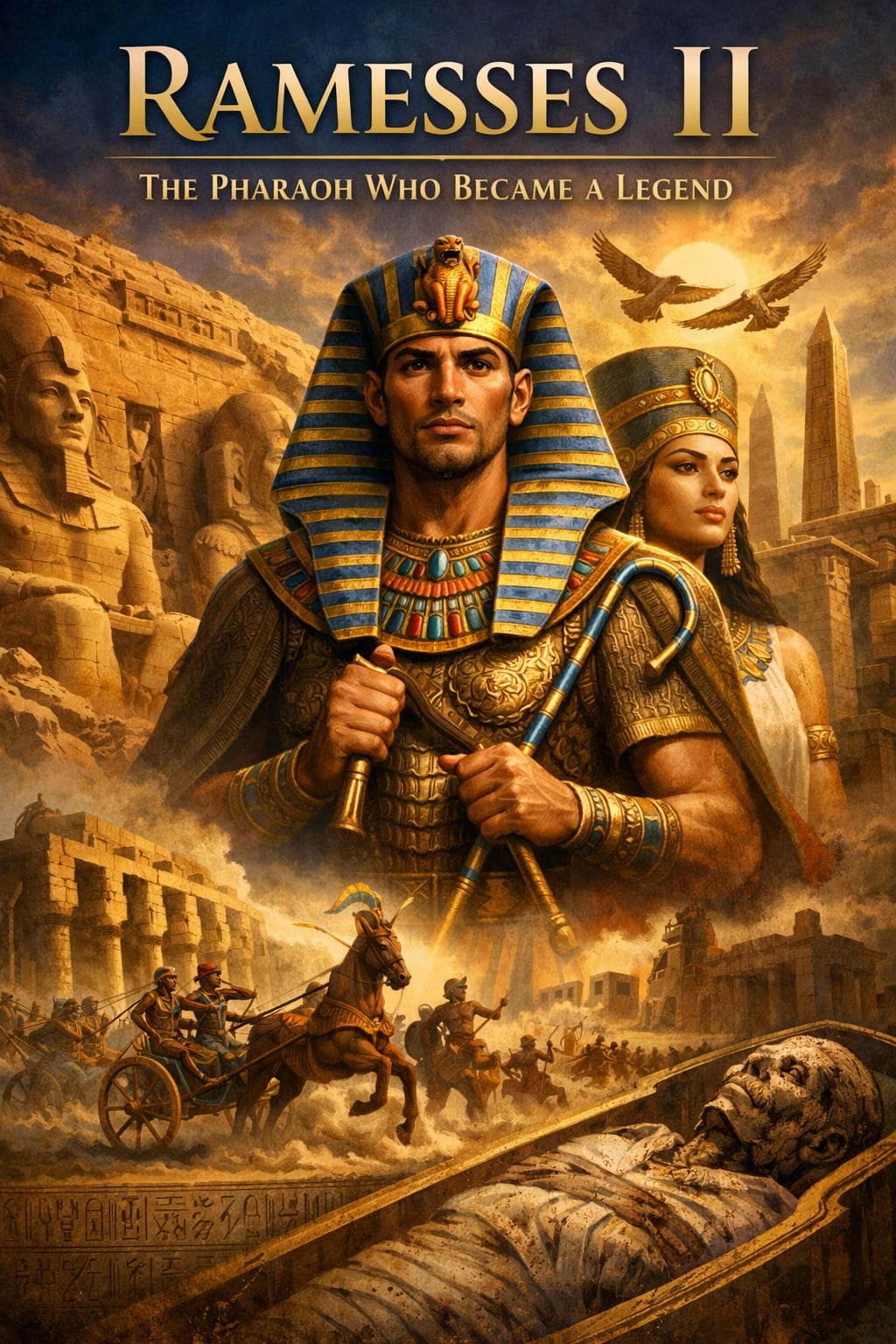
Ramesses II, often known as Ramesses the Great, was one of the most powerful and celebrated rulers of ancient Egypt. He reigned for an extraordinary 66 years, from 1279 to 1213 BCE, during the height of the New Kingdom. His long reign, military achievements, and monumental building projects earned him a place among the most iconic figures in human history.
Born into the 19th Dynasty, Ramesses II was the son of Seti I, a successful pharaoh who restored stability and power to Egypt after a period of unrest. From a young age, Ramesses was groomed for leadership. By his teenage years, he had already accompanied his father on military campaigns, gaining valuable experience that would shape his future rule.
When Ramesses II ascended to the throne, he inherited a strong and prosperous kingdom. However, he was not content with maintaining the status quo. He sought to expand Egypt’s influence and secure its borders, particularly in the north where the powerful Hittite Empire posed a constant threat. This ambition led to one of the most famous military confrontations in ancient history—the Battle of Kadesh.
The Battle of Kadesh, fought against the Hittite king Muwatalli II, is often considered one of the largest chariot battles ever recorded. Although the outcome was not a clear victory for either side, Ramesses II portrayed it as a great triumph in his inscriptions. He had the story carved into temple walls across Egypt, showcasing himself as a heroic warrior personally leading his troops to victory. This use of propaganda helped solidify his image as a powerful and invincible ruler.
Despite the inconclusive nature of the battle, Ramesses II later made history by signing one of the world’s first known peace treaties with the Hittites. This agreement brought stability to the region and allowed both empires to focus on internal development rather than constant warfare.
Beyond his military exploits, Ramesses II is perhaps best remembered for his extraordinary building projects. He commissioned an immense number of temples, statues, and monuments throughout Egypt, more than almost any other pharaoh. Among his most famous constructions is the magnificent Abu Simbel, a pair of rock temples carved into a mountainside. The larger temple features four colossal statues of Ramesses himself, each standing about 20 meters tall, symbolizing his divine power and eternal presence.
He also expanded the great temples at Karnak and built a new capital city called Pi-Ramesses in the Nile Delta. These projects were not only displays of wealth and power but also served religious and political purposes, reinforcing the pharaoh’s connection to the gods and his role as the protector of Egypt.
Ramesses II’s personal life was equally remarkable. He is believed to have had over 100 children and numerous wives, the most famous being Queen Nefertari. He honored Nefertari by building a beautiful temple dedicated to her at Abu Simbel, a rare privilege that highlighted her importance and influence.
One of the most fascinating aspects of Ramesses II’s legacy is how he managed to maintain power for such a long time. His reign brought stability, economic prosperity, and cultural flourishing to Egypt. By the time of his death, he had become a living legend, with generations knowing no other ruler.
After his death, Ramesses II was buried in the Valley of the Kings. His mummy, discovered centuries later, revealed that he lived to an old age, likely in his 90s, which was remarkable for that time. Today, his remains are preserved in a museum in Cairo, continuing to captivate historians and visitors alike.
In conclusion, Ramesses II was far more than just a king; he was a symbol of strength, ambition, and enduring legacy. Through his military campaigns, diplomatic achievements, and monumental architecture, he shaped the course of ancient Egyptian history. Even thousands of years later, his name remains synonymous with greatness, making him truly deserving of the title “Ramesses the Great.”
About the Creator
Irshad Abbasi
Ali ibn Abi Talib (RA) said 📚
“Knowledge is better than wealth, because knowledge protects you, while you have to protect wealth.
Keep reading
More stories from Irshad Abbasi and writers in History and other communities.
The Emperor Who Transformed Rome
Constantine the Great, also known as Flavius Valerius Constantinus, stands as one of the most influential figures in world history. Born around 272 CE in the Roman province of Moesia (modern-day Serbia), Constantine rose from a turbulent political landscape to become the first Roman emperor to embrace Christianity. His reign marked a turning point not only for the Roman Empire but also for the future of European civilization.
By Irshad Abbasi about 15 hours ago in History
Church Anniversary and Founders Day: The purpose and focus is different
Founders Day or Church Anniversary? Jesus said in Matthew 16:18 that His church would be founded on the revelation of who Peter said He was, which was "the Christ, the Son of the Living God." In Christian churches, you will hear about Founder's Day and Church Anniversary.
By Cheryl E Preston6 days ago in History


Comments
There are no comments for this story
Be the first to respond and start the conversation.