
From Crisis To Camera
The actor who treated trauma patients before he played them
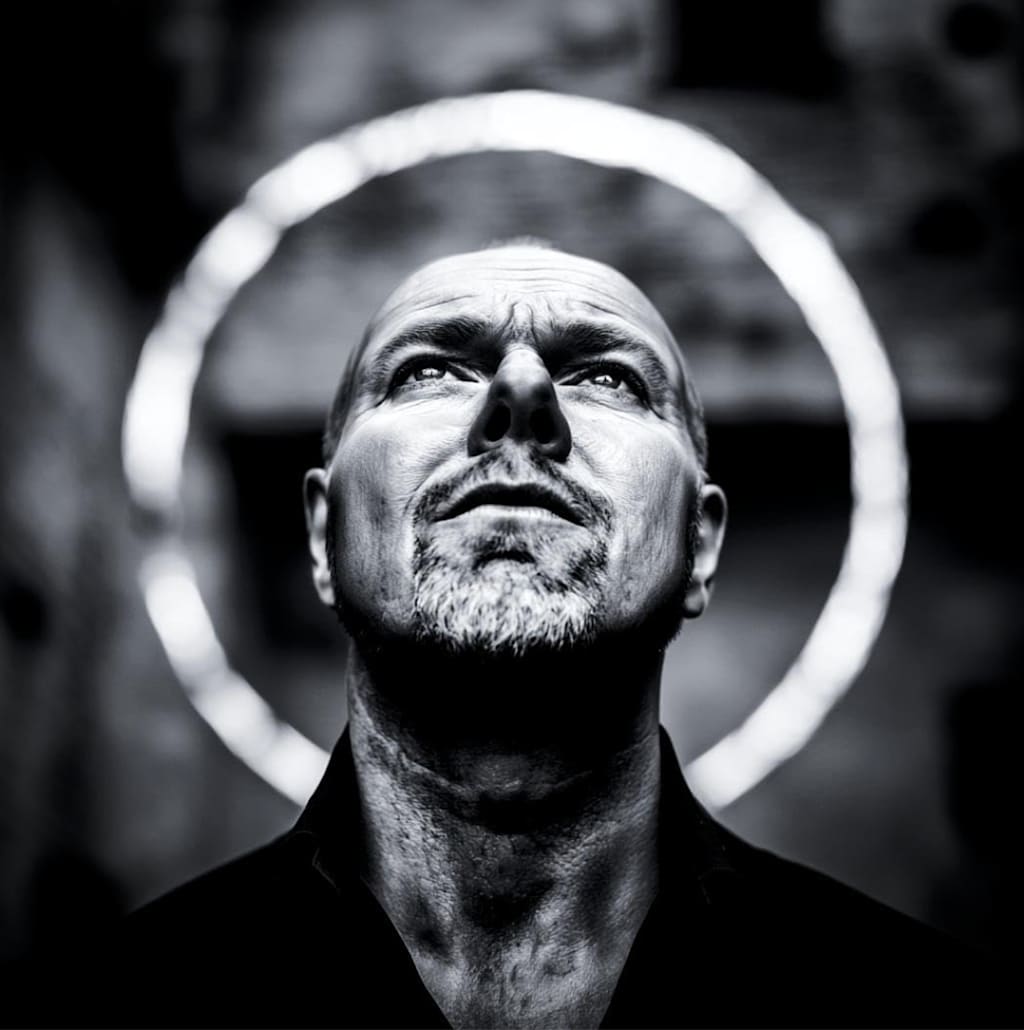
Dan Martin spent years as a paramedic, a bodyguard and a martial artist before he ever stood in front of a camera. Now, with a slate of international film projects and a philosophy about the industry that unsettles its comfortable myths, he is making a case for a different kind of actor entirely
There is a particular kind of stillness that comes from having been in genuinely dangerous situations. Not the performed calm of someone who has studied it, but the real thing - the settled quality of a person who has learned, through repetition and necessity, that panic is a luxury. Sitting with Dan Martin, it is this quality that registers first, before he has said very much at all.
Martin is 40, German-born, built with the compactness of someone who has used his body professionally for most of his adult life. He has been, in roughly chronological order: a martial artist, a military police officer, a paramedic, a close protection operative, and now - with increasing seriousness and a growing slate of film and television work to support the claim - an actor. The transition from one to the other was, he insists, less of a leap than it might appear.
"I didn't start in front of the camera," he says, settling into the conversation with the unhurried ease of someone accustomed to high-stakes rooms. "I started in environments where performance wasn't optional. Where presence was survival."
It is a striking reframe, and it sets the tone for everything that follows. Because Martin is not, it becomes clear, interested in the standard actor's biography - the drama school foundation, the years of small theatre work, the casting that changed everything. He has a different story. And he has thought carefully about what it means.
The paramedic years are where he most often begins. Not because they are the most cinematic chapter - though there is plenty of material there - but because they gave him something he argues acting school cannot fully replicate: direct, unmediated access to human beings in extremis.
"As a paramedic, you're dealing with people at their most raw. There's no performance in that room. There's no script. You have to be completely present, completely clear, and completely human - all at once."
He pauses. "That taught me something about emotion that no class can teach you. The difference between feeling something and using it."
The distinction matters to him. A significant portion of screen acting, he suggests, is the performance of emotion - the signalling of inner states through learned technique. What his background gave him instead was recognition. When he builds a character, he is not inventing from nothing. He is translating something he has already witnessed.
"A man under pressure," he says. "Someone who has to hold it together when everything is falling apart. Someone whose stillness is more dangerous than someone else's noise. I've been in rooms with all of those people. I know what they feel like from the inside."
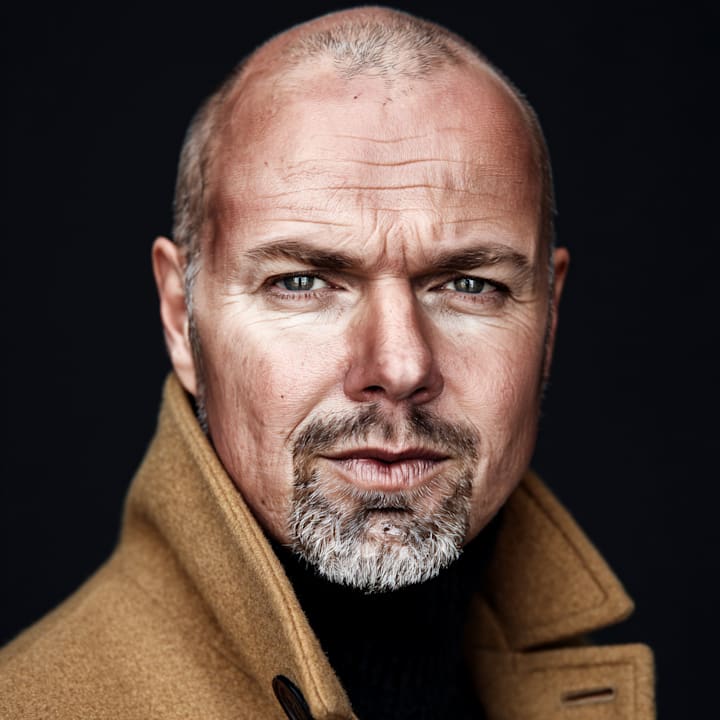
His martial arts training - he holds black belts across multiple disciplines - adds another layer. Not the physical dimension, which he regards as almost incidental, but the philosophical one. The relationship with repetition. The understanding that genuine mastery becomes invisible precisely because it is so deeply embedded. "Thousands of hours of doing the same thing," he says, "until your body stops thinking and starts knowing."
And then there is the bodyguard work, the close protection years, which refined something perhaps the most useful of all for an actor: the ability to read a room before it speaks. To notice the shift in energy before it manifests. To understand that the most significant thing happening in any given space is often the thing nobody is saying.
"You're always watching for the shift that hasn't happened yet. That becomes instinct. And instinct, on camera, is everything."
Martin is currently based between Europe and, increasingly, the United States, where a collaboration with agent Cheryl Murphy and Spectrum Global Agency is building the infrastructure for what he calls his American chapter. He is in the final stages of the O-1 visa process - the classification reserved for individuals of extraordinary ability - a bureaucratic milestone that he describes with characteristic precision.
"People hear O-1 and they think: achievement. One big thing that got you there. But it doesn't work like that. It's the accumulation. Hundreds of smaller, consistent decisions that compound over time. No single thing got me there. The accumulation did."
His current film slate bears this out. He is simultaneously in production on three projects of notably different registers. Deep Frame, directed by Henning Morales, casts him as Brandon Sanders - a character whose power resides entirely in perception, in the ability to map the dynamics of a room before its occupants have consciously registered them.
"He's not the loudest person in the space," Martin says. "But he's the one who understands it." It is a role that demands the particular kind of internal work that registers only in close-up, where there is nowhere to hide behind noise or movement.
The Rose in the Flame operates at a different scale entirely - a historical drama set against a landscape of conflict, hierarchy and survival, in which Martin plays Eric, a character navigating the perpetual tension between external pressure and internal conviction. And Pict's Sword, directed by Rick McLeod, extends his range into the territory of myth and epic storytelling, where the demands on both physical and emotional register are turned significantly upward.
"These projects aren't separate experiments," he says. "They're different expressions of the same direction. I'm not jumping from one thing to another trying to prove range. I'm deepening something."
Alongside the film work, he is also writing. His YA series Stadtgeister - City Ghosts - is scheduled for publication in 2027, exploring what he describes as the defining psychological landscape of the current generation: the gap between the self that is performed online and the self that is actually experienced. A second book, Regenbogenbrücke, moves into quieter emotional territory - loss, memory, and the question of what we carry from the people who leave our lives.
"As an actor, I step into characters," he says. "As a writer, I create them. Both require you to understand people from the inside. But writing gives me control over the architecture in a way that acting doesn't. I'm not waiting to be cast. I'm building the world from the ground up."
The word "building" recurs throughout the conversation. It is, one begins to understand, not incidental. It is the central metaphor of a philosophy he has arrived at through some difficulty.
The philosophy has a name. Martin calls it the Actorpreneur mindset, and he is aware that the word invites scepticism. The film industry has a long tradition of romanticising the artist as innocent, unburdened by commercial consideration - the idea that to think strategically about a career is somehow to compromise the purity of the work. He rejects this entirely.
"People throw around 'show business' like it's a cliché," he says. "But it's the most honest description we have of what this actually is. It's show - the craft, the performance, the storytelling. And it's business - strategy, positioning, relationships, visibility. You can be brilliant at the first part and completely invisible because you've ignored the second."
This is not, he is careful to say, a counsel of cynicism. He is not arguing that art should be subordinated to commerce, or that the work matters less than the packaging. He is arguing that the two things are not in opposition - that understanding the ecosystem your work exists within is not a compromise of your artistic integrity but a precondition of your artistic survival.
"If you don't understand the system, you're entirely at its mercy."
The insight came, in part, through a near-miss. Some years ago, Martin found himself in consideration for a role in an Expendables sequel - a project that he describes as carrying unusual personal weight. "These were the films I grew up watching. Stallone, Statham, that whole world - it was the mythology of action cinema for my generation." The role did not materialise. But the experience cracked open a question he had not previously asked himself directly: what, exactly, was he waiting for?
What followed was a conversation with Will Roberts, a US actor who had recently completed work on Christopher Nolan's Oppenheimer, that reoriented his understanding of the industry at its foundations. "What landed," he says, "was this: talent is the entry requirement, not the currency. The industry doesn't move on talent alone. It moves on visibility, momentum, and positioning."
The harder truth Martin identifies - the one he says is most common in the industry and least discussed - is what he calls movement without direction. The actor who is doing everything right: the self-tapes, the networking, the classes, the auditions. Working constantly. And looking up after two years to find themselves in exactly the same position.
"That's not failure. That's misalignment."
The industry, he argues, has shifted. The question is no longer primarily whether an actor can perform. It is whether they are legible - clear enough, specific enough, to be placed within a context without risk. "If a casting director can't immediately understand where you fit," he says, "they can't take the risk. The market moves too fast."
The corollary is something he calls the black sheep principle. In any system, he argues, the non-conforming element is first perceived as friction. It creates problems. It doesn't follow the established pattern. But under real pressure - when the system needs something the standard template cannot provide - that is the element that becomes indispensable. "Not despite its difference," he says. "Because of it."
Applied to identity, the logic is unsparing. "The industry doesn't need another version of someone it already has," he says. "The moment you position yourself as a variation of someone else, you become replaceable. Because you're always going to be a worse version of the original. Define your difference precisely enough, and you're not in competition with anyone. You become the only option for a particular kind of story."
Toward the end of our conversation, Martin reaches for an image that lingers. He describes the industry as a train journey. People board at different stations, travel alongside you for a time, and disembark. Some leave quietly, some leave an impression you carry for the rest of the journey. Careers move at different speeds; people end up in different carriages. Proximity does not guarantee permanence.
"What I keep coming back to is: what did you add to someone's journey while you were alongside them? Did you leave their luggage heavier - not with weight, but with value?"
It is, for an industry so often characterised by transactional thinking, an unexpectedly humane formulation. And it reveals something about Martin that the professional biography, for all its impressiveness, does not quite capture: that beneath the strategic clarity, the philosophical precision, the very deliberate construction of a career, there is someone who has thought seriously about what this work is actually for.
He is not, he says, trying to break into anything anymore. He is building. The distinction, delivered quietly and without drama, lands with the weight of everything that came before it.
It tends to, when someone means it.
----------------------------------------------------------------------------------------
Dan Martin is currently in production on Deep Frame (dir. Henning Morales), The Rose in the Flame, and Pict's Sword (dir. Rick McLeod). His literary series Stadtgeister and Regenbogenbrücke are scheduled for release from 2027. He is represented in the U.S. by Spectrum Global Agency.
About the Creator
Alex Wilkins
Journalist for over 25 years, author of over 14 published books and an award-winning screenwriter.
Keep reading
More stories from Alex Wilkins and writers in Interview and other communities.
The Invisible Influencer
In an industry obsessed with celebrity, video editor Tian Xu has built her career in the shadows—helping free wrongfully detained prisoners, crafting viral content for millions, and proving that sometimes the most powerful voices are the ones we never see.
By Alex Wilkins10 months ago in Interview
The Untold Story of Enzo Zelocchi and His Vision for Modern Filmmaking
In an era where the film industry is constantly evolving, few creatives manage to balance artistic integrity with modern demands. Enzo Zelocchi is one of those rare individuals whose journey reflects both ambition and adaptability. While much of the spotlight in entertainment focuses on blockbuster success and celebrity culture, Zelocchi’s story offers a deeper perspective—one rooted in vision, purpose, and a commitment to redefining how stories are told.
By Brian Smith2 days ago in Interview




Comments
There are no comments for this story
Be the first to respond and start the conversation.