
Under the Rivers Conditions
What the river takes, and what it leaves behind

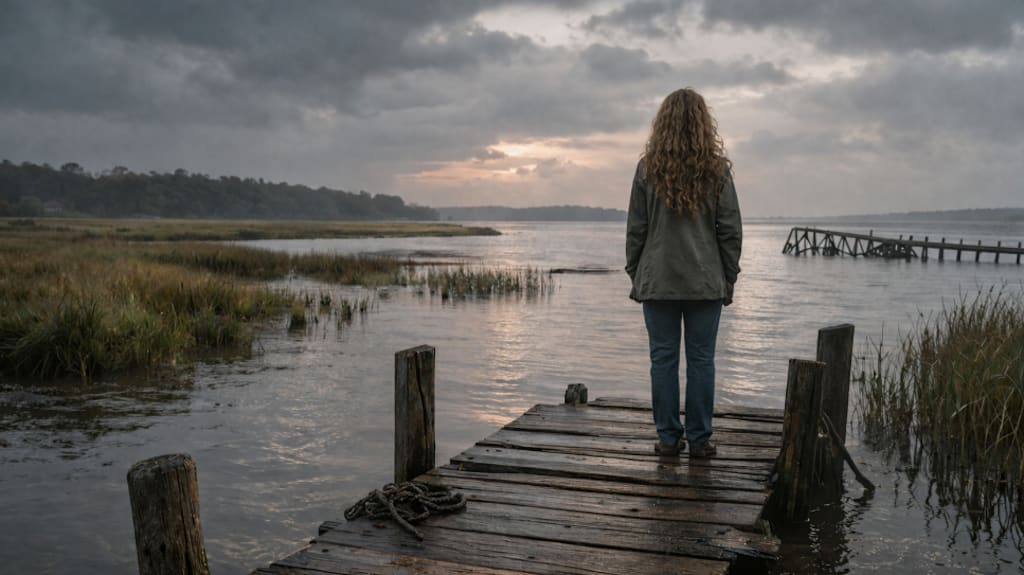
The river does not rise the way it used to.
It comes farther now—quiet and patient.
Not all at once, not in the way storms announce themselves.
It moves in inches. The kind of change you can deny if you need to.
The old dock used to sit above the waterline.
You could stand there and see the marsh stretch out in layers—grass, mud, tide, sky.
Now the boards stay damp even when the tide is supposed to be out.
The nails have started to lift. Wood remembers what it holds.
She still comes most afternoons.
Same place. Same hour. As if time can be kept by habit alone.
There’s a ledger in her house. Not written.
Not bound. Just a drawer that doesn’t close all the way anymore.
Receipts, letters, things that were once proof of something—ownership, payment, agreement.
Things that say this happened, whether the body agrees or not.
She doesn’t open it much now.
The river keeps better records.
The first time the water crossed the grass line, the town called it an anomaly. The second time, they called it weather.
By the third, they stopped naming it at all.
There are places along the bank where the ground gives without warning. What looks solid isn’t. You learn that by watching, or by stepping wrong.
The old man down the road tried to hold his line.
Drove posts deeper. Reinforced what had already started to shift. Said the land had always been there. Said it would stay.
The river took the first row of posts without much effort.
Not a storm. Not a surge. Just a slow pull over time. Enough to loosen what he thought was fixed.
He doesn’t come down to the water anymore.
She saw it before most.
Not because she was looking for it—because she had spent too long learning how things change without announcing themselves.
The marsh breathes differently now.
High tide stays longer. Low tide doesn’t fall as far. The edges blur. Boundaries that once held begin to soften, then disappear.
Nothing collapses all at once.
It adjusts.
There used to be more turtles.
You’d see them in the early evening, cutting through the surface, steady and unbothered.
Now they come closer to the houses. Closer than they should.
Last summer, one laid its eggs too near the waterline. The ground was warmer than it should have been.
The sand held the heat. When the tide came in, it didn’t hesitate.
There was nothing left by morning.
She stands on the dock and watches the line where the river opens toward the sea.
It used to feel distant. Something separate. Now it feels closer. As if the river has begun remembering where it’s going.
People talk about fixing things. Barriers. Reinforcements. Ways to hold the water where it used to be.
But the river doesn’t recognize those kinds of decisions.
It does not argue.
It does not negotiate.
It keeps.
The first time she let something go, it felt like failure.
The second time, it felt like loss.
Now it feels like standing where the ground has already shifted.
Not what she wanted.
What remains.
The dock will not last much longer. You can see it in the way the boards shift under weight. In the way the water touches places it didn’t before.
She doesn’t try to repair it.
Some structures are meant to hold for a time. Not forever.
The drawer at home is still there.
Still open.
Still full.
But it no longer asks to be sorted.
The river has its own conditions.
What it takes, it takes completely.
What it leaves, it leaves altered.
Nothing is returned the way it was given.
She steps off the dock before the tide turns.
The path back is narrower now.
The ground less certain.
Still, it holds.
For now.
About the Creator
Ginny Brown
My writing is grounded in lived experience, legal accuracy, and a commitment to equity, with a focus on ethical storytelling that illuminates systemic challenges and amplifies unheard voices.
Keep reading
More stories from Ginny Brown and writers in Journal and other communities.


Comments
There are no comments for this story
Be the first to respond and start the conversation.