
Online Grocery Market Set to Surpass US$3.6 Trillion by 2033 as Digital Shopping Transforms Food Retail
Convenience, Technology, and Rapid Delivery Networks Are Driving the Next Era of Grocery Shopping Worldwide

Introduction
The global grocery industry is experiencing one of the most significant transformations in modern retail history. Consumers are increasingly shifting from traditional in-store grocery shopping to digital platforms that offer convenience, speed, and personalized experiences. Online grocery services allow shoppers to browse, order, and receive food and household essentials without leaving their homes — a model that has grown rapidly thanks to technological advancements and changing lifestyles.
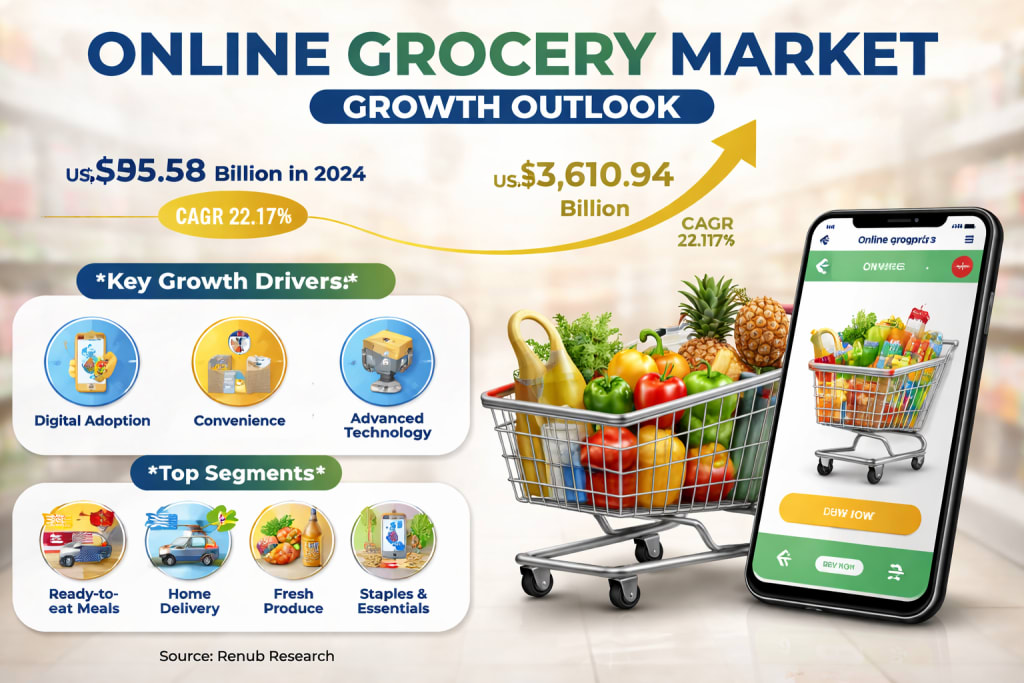
According to Renub Research, the online grocery market size reached US$595.58 billion in 2024 and is projected to surpass US$3,610.94 billion by 2033, expanding at a remarkable CAGR of 22.17% between 2025 and 2033. This extraordinary growth reflects the rising adoption of e-commerce platforms, the increasing penetration of smartphones and internet connectivity, and the growing demand for faster and more convenient shopping solutions.
From AI-powered recommendation systems to same-day delivery and subscription meal services, the online grocery ecosystem is evolving rapidly. Retailers, technology companies, and logistics providers are all investing heavily to capture a share of this fast-growing market.
Understanding the Online Grocery Market
Online grocery shopping refers to the purchase of food products and household essentials through digital channels such as websites or mobile applications. Consumers can select products ranging from fresh fruits and vegetables to packaged foods, beverages, dairy products, cleaning supplies, and personal care items.
Once an order is placed, the groceries are either delivered directly to the customer’s doorstep or collected from a nearby store through a click-and-collect system.
The digital grocery model offers several advantages over traditional retail shopping, including:
Shopping from home at any time
Easy product comparisons
Personalized recommendations
Scheduled delivery options
Access to specialty or organic products
Many online grocery platforms also provide features such as subscription services, automated reordering, and tailored promotions. These tools allow retailers to create a more personalized and convenient shopping experience, helping them build stronger customer loyalty.
Urbanization, busier lifestyles, and technological innovation have all contributed to the rapid adoption of online grocery shopping across the world.
Key Growth Drivers of the Online Grocery Market
Rising Digital Adoption and Internet Penetration
One of the most powerful drivers of the online grocery market is the rapid expansion of internet connectivity and smartphone usage worldwide.
Consumers today are more digitally connected than ever before. Online platforms allow shoppers to browse thousands of products with just a few taps on their smartphones. Even rural and remote areas are gaining access to reliable internet services, expanding the potential customer base for online grocery retailers.
Research indicates that adults in the United States aged 18 and above spend an average of 3 hours and 45 minutes per day on mobile internet activities in 2024. This increased screen time naturally translates into greater engagement with e-commerce platforms.
As digital literacy improves and consumers become more comfortable making online purchases, the online grocery sector continues to attract millions of new users each year.
Growing Demand for Convenience and Time Savings
Modern consumers increasingly prioritize convenience. Busy work schedules, long commuting times, and family responsibilities leave many people with limited time for traditional grocery shopping.
Online grocery platforms eliminate the need to travel to physical stores, search for products, and wait in checkout lines. Instead, shoppers can place orders within minutes and schedule deliveries according to their preferred time.
This convenience particularly appeals to:
Working professionals
Young families
Elderly consumers
People with mobility challenges
Many platforms now also offer scheduled deliveries, subscription grocery services, and automated reordering, ensuring that essential items are replenished without additional effort from customers.
As lifestyles continue to become more fast-paced, the demand for digital grocery solutions is expected to grow even further.
Advanced Technology Enhancing Customer Experience
Technology is reshaping the online grocery experience and making it more efficient, personalized, and engaging.
Retailers are increasingly adopting innovations such as:
Artificial Intelligence (AI) for product recommendations
Voice-activated ordering systems
Real-time delivery tracking
Automated warehouse logistics
Secure digital payment systems
Data analytics also allows companies to analyze customer behavior and offer personalized promotions based on individual preferences.
For example, AI-driven recommendation engines suggest products that customers are more likely to purchase, increasing engagement and repeat orders.
Social commerce is another emerging trend. In June 2023, TikTok launched its e-commerce business in the United States after months of testing, allowing users to discover and purchase products directly through the platform.
These technological innovations are not only improving the shopping experience but also strengthening operational efficiency for online grocery retailers.
Challenges in the Online Grocery Market
Despite its rapid expansion, the online grocery industry faces several operational and financial challenges.
Logistics and Delivery Complexity
Managing logistics for online grocery delivery is far more complex than delivering non-perishable products.
Fresh produce, dairy products, and meat require careful handling and temperature-controlled transportation to maintain quality. Retailers must ensure that groceries arrive fresh, intact, and on time.
However, achieving this level of efficiency involves significant costs.
Major logistical challenges include:
Cold chain management
High last-mile delivery expenses
Traffic congestion in urban areas
Delivery errors and product damage
Retailers often invest heavily in distribution centers, refrigerated vehicles, and advanced routing technologies to address these issues.
Even with these investments, maintaining profitability while meeting customer expectations for fast delivery remains a significant challenge.
Intense Competition and Price Sensitivity
The online grocery market is highly competitive, with both global retail giants and local startups competing for customers.
Consumers frequently compare prices across multiple platforms before making a purchase. As a result, companies must offer competitive pricing, discounts, and loyalty rewards to retain customers.
Large retailers often benefit from economies of scale and established logistics networks, giving them an advantage over smaller competitors.
Balancing affordable pricing with sustainable profit margins remains one of the biggest challenges for companies operating in the online grocery space.
Online Ready-to-Eat Subscription Grocery Market
Subscription-based grocery services are emerging as a fast-growing segment within the online grocery market.
These services allow customers to subscribe to regular deliveries of ready-to-eat meals or meal kits. The model is particularly popular among busy professionals and health-conscious consumers who prefer convenient yet nutritious meal options.
Key features of subscription grocery services include:
Customizable meal plans
Flexible delivery schedules
Diet-specific meal options
Reduced food preparation time
Innovations in sustainable packaging, fresh ingredient sourcing, and meal variety are further driving the popularity of subscription-based grocery models.
As consumers increasingly seek healthier and time-saving food solutions, the ready-to-eat subscription market is expected to continue expanding globally.
Home Delivery: The Core of Online Grocery Shopping
Home delivery remains the most widely used method in the online grocery market.
Customers can order groceries from supermarkets, specialty food retailers, or online platforms and receive them directly at their doorstep.
Major companies such as Amazon Fresh, Walmart, and various regional grocery chains offer flexible delivery options including:
Same-day delivery
Scheduled delivery
Express delivery within hours
Mobile apps and real-time tracking systems further enhance the customer experience by allowing shoppers to monitor their orders throughout the delivery process.
The convenience of doorstep delivery continues to drive the growth of online grocery services worldwide.
Regional Insights
United States Online Grocery Market
The United States remains one of the most advanced and influential online grocery markets globally.
A tech-savvy population, strong e-commerce infrastructure, and widespread smartphone usage have contributed to the rapid adoption of online grocery services.
Major retailers such as Walmart and Kroger have invested heavily in digital platforms to provide seamless online shopping experiences.
Third-party delivery services like Instacart have also played a key role in expanding access to grocery delivery.
In April 2024, Walmart introduced a new private-label grocery brand called Bettergoods, offering chef-inspired and trend-focused food products designed to attract online shoppers.
United Kingdom Online Grocery Market
The United Kingdom has one of the most mature online grocery markets in Europe.
Retail giants including Tesco, Sainsbury’s, and Asda provide highly efficient online ordering systems combined with reliable delivery networks.
Companies like Ocado specialize exclusively in online grocery retail and have helped shape the modern e-grocery ecosystem.
Consumer demand for healthier products, combined with the shift toward contactless shopping during the COVID-19 pandemic, significantly accelerated online grocery adoption in the UK.
In September 2024, Co-op expanded its services by introducing 24-hour online grocery delivery across the UK, allowing consumers to order groceries at any time of day.
China Online Grocery Market
China is one of the fastest-growing online grocery markets, driven by a strong digital ecosystem and widespread adoption of mobile payments.
Major e-commerce platforms such as Alibaba’s Tmall and JD.com dominate the market, offering extensive grocery product selections and advanced logistics capabilities.
Technology integration plays a major role in China's e-grocery expansion, including AI-powered inventory management and automated warehouses.
In February 2023, Douyin entered the online supermarket segment by launching its own e-commerce grocery platform, further intensifying competition in the Chinese market.
Brazil Online Grocery Market
Brazil leads the online grocery market in Latin America, fueled by increasing smartphone penetration and internet accessibility.
Retailers such as Carrefour and Grupo Pão de Açúcar (GPA) have expanded their digital grocery services to meet rising consumer demand.
The COVID-19 pandemic accelerated the adoption of online grocery shopping across Brazil, particularly in major urban areas.
In October 2024, iFood, Brazil’s largest food delivery platform, acquired a minority stake in the grocery delivery startup Shopper, signaling a major push into the online grocery sector.
United Arab Emirates Online Grocery Market
The United Arab Emirates has also seen rapid growth in online grocery adoption due to its tech-savvy population and strong digital infrastructure.
Major platforms such as Carrefour UAE, Instashop, and Zadina provide consumers with convenient grocery ordering and quick delivery services.
In December 2024, Carrefour UAE launched an all-day express grocery delivery service in Dubai, enabling faster and more flexible access to grocery products.
With increasing consumer demand for convenience, the UAE’s online grocery market is expected to continue expanding rapidly.
Online Grocery Market Segmentation
The online grocery market is segmented across several categories.
By Product
Ready-to-eat Breakfast & Dairy
Staples & Cooking Essentials
Snacks & Beverages
Meat & Seafood
Fresh Produce
Others
By Purchaser Type
Ready-to-eat Subscription Purchase
One-time Purchase
By Delivery Type
Click & Collect
Home Delivery
By Payment Mode
Online Payment
Cash on Delivery
By Region
The market covers 25 countries across North America, Europe, Asia-Pacific, Latin America, and the Middle East & Africa.
Key Companies in the Online Grocery Market
Several major retail companies are shaping the competitive landscape of the global online grocery industry.
Key players include:
Tesco Plc.
Walmart Inc.
Auchan SA
The Kroger Co.
Carrefour
Costco Wholesale Corporation
Koninklijke Ahold Delhaize N.V.
Target Corporation
These companies continue to invest heavily in digital infrastructure, logistics networks, and artificial intelligence to strengthen their positions in the rapidly evolving online grocery market.
Final Thoughts
The online grocery market is undergoing a powerful transformation as technology, convenience, and digital lifestyles reshape consumer shopping habits.
With the market projected to grow from US$595.58 billion in 2024 to over US$3,610.94 billion by 2033, the sector represents one of the fastest-growing segments within global retail.
Retailers that successfully combine advanced technology, efficient logistics, and customer-focused services will be best positioned to thrive in this highly competitive landscape.
As consumers continue to embrace digital shopping experiences, the future of grocery retail will increasingly be defined by speed, personalization, and seamless online convenience.
About the Creator
Australia Electric Truck Market: The Fast-Growing Green Logistics Revolution
Australia transportation industry is undergoing a major transformation as logistics operators, construction companies, and municipal fleets begin transitioning from diesel-powered vehicles to electric alternatives. Electric trucks are increasingly viewed as a practical solution for reducing emissions, lowering operating costs, and meeting sustainability commitments across the freight and logistics ecosystem.
By Rashi Sharmaabout 10 hours ago in Trader
Philippines Computer Vision Market 2026: AI Adoption, Smart Surveillance & Industrial Automation
Philippines Computer Vision Market Overview The Philippines computer vision market is an emerging segment of the country’s artificial intelligence and digital technology ecosystem. Computer vision technologies enable machines and systems to interpret and analyze visual information from images and videos using advanced algorithms and machine learning models. These solutions are widely used in applications such as security surveillance, quality inspection, facial recognition, retail analytics and healthcare imaging.
By Manisha Dixit4 days ago in Trader




Comments
There are no comments for this story
Be the first to respond and start the conversation.