Peter Ayolov
Bio
Peter Ayolov’s key contribution to media theory is the development of the "Propaganda 2.0" or the "manufacture of dissent" model, which he details in his 2024 book, The Economic Policy of Online Media: Manufacture of Dissent.
Stories (76)
Filter by community
Celluloid Comrades
A review of: Nadège Ragaru (2023). ‘Millions for the Movies’ in Late Socialist Bulgaria: : The Political and Moral Economy of the Cinema Industry. Sociétés politiques comparées. Revue européenne d’analyse des sociétés politiques . [online] doi:https://doi.org/10.36253/spc-18718.
By Peter Ayolov18 days ago in Critique
Mirror Selves Trilogy: The Architecture of the Formatted Human
Mirror Selves Trilogy: The Architecture of the Formatted Human The Mirror Selves Trilogy—Identity Industrial Complex, Copyrighting the Self, and The Shapes of the Self—offers one of the most systematic contemporary analyses of how identity has migrated from lived interiority to formatted visibility. Across its three volumes, Peter Ayolov develops a coherent theoretical architecture that traces the transformation of the self from a psychological and philosophical category into a political, economic, and technological construct. What begins as an inquiry into representation unfolds into a diagnosis of civilizational change: the shift from narrative selfhood to infrastructural identity, from subjectivity to profile, from history to circulation. At the core of the trilogy stands a simple but destabilizing claim: identity no longer precedes representation. It is formatted by it. The trilogy does not treat this as metaphor. It is not a cultural lament about social media narcissism or a nostalgic defense of authenticity. It is an ontological and political thesis. The human being, once imagined as a bearer of interior depth, now appears as a visible configuration inside systems of recognition. The mirror no longer reflects; it produces.
By Peter Ayolov18 days ago in BookClub
The Shaped Self: Images Without History
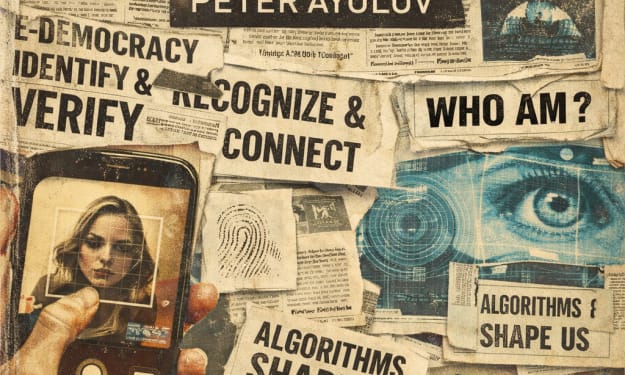
The Shaped Self: Images Without History Peter Ayolov, Sofia University “St. Kliment Ohridski”, 2026 Abstract E-democracy is not a technical upgrade of representative government. It is a transformation of citizenship inside a regime of visual formatting. Drawing on Žarko Paić’s analysis of video-centrism and the world-picture, this article argues that contemporary political life unfolds in an environment where images no longer reflect history but organise reality in advance. In this condition, the citizen does not merely participate; the citizen appears through an interface. Political agency becomes inseparable from visibility, recognisability, and circulation. By placing Paić in dialogue with Marcel Duchamp, Jean Baudrillard, Tom Wolfe, and Jean-Luc Nancy, the article develops the concept of the shaped self as the central figure of e-democracy: an interface-formed subject structured by edges, templates, and repeatable visual patterns that enable identification but risk reducing agency to performance. The struggle for democracy becomes a struggle over representation itself: over ownership of likeness, transparency of distribution systems, and the capacity to distinguish voice from simulation in an environment saturated with images, metrics, and deepfakes. As the concluding work of the Mirror Selves Trilogy, this article presents the book The Shapes of the Self: Identity and Recognition in Visual Space (2026) that investigates how the self emerges not as an inner essence but as a shaped and formatted presence within contemporary visual space.
By Peter Ayolov18 days ago in Critique
Peter Ayolov’s The Shapes of the Self: Identity and Recognition in Visual Space
Peter Ayolov’s The Shapes of the Self: Identity and Recognition in Visual Space (Book review) Peter Ayolov’s The Shapes of the Self: Identity and Recognition in Visual Space arrives not as an isolated philosophical meditation but as the culminating movement of the Mirror Selves Trilogy, following Identity Industrial Complex and Copyrighting the Self. If the first volume mapped the political economy of the human image and the second traced the juridical and proprietary capture of likeness, this final work undertakes the most ontological task of all: to ask what kind of self remains when the world itself has become image.
By Peter Ayolov18 days ago in BookClub
Love Is Folly 2016
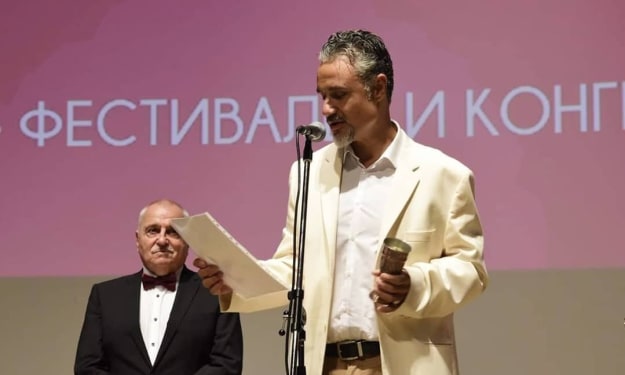
Love Is Folly 2016: Peter Ayolov Between Cinema, Education and Memory In 2016, at the International Film Festival Love Is Folly in Varna, Dr Peter Ayolov—lecturer in screenwriting at Sofia University St. Kliment Ohridski and author of the book Медийният сценарий (2026)—was invited to serve as a member of the festival jury. His participation marked not only a professional recognition of his work in media and narrative theory, but also placed him at the intersection of Bulgarian cinematic history and contemporary film education.
By Peter Ayolov23 days ago in Art
2012, Shale Gas and... Bright Future
Shale Gas and a Bright Future: Looking back at the birth of post-truth In 2012 Bulgaria experienced what looked like a classic modern conflict: a global corporation wanted to extract shale gas, students protested to protect land and water, media polarised the public, politicians divided into camps, and the government imposed a moratorium. At the time the story appeared simple — nature versus profit, citizens versus corporations, science versus fear.
By Peter Ayolov24 days ago in Critique
“Share Yourself (!)”
SHARE YOURSELF (!) It was the time after the Covid lockdowns, when the city reopened but many people did not quite return to their own lives. The story that follows was born from that atmosphere, where silence became habit and solitude learned to speak in a human voice.
By Peter Ayolov24 days ago in Art
The Film Project “Share (!) Yourself” 2020
From Script to Structure: The Film Project “Share (!) Yourself” In 2020 the screenplay competition organised by “The Palace / The Palace of the Happy People” gathered nearly one hundred texts from across Bulgaria. What began as a typical selection process quickly turned into an intensive reading marathon. Producer Dimitar Gochev and Dr. Peter Ayolov carefully examined every submission — not simply evaluating technical correctness, but searching for cinematic potential: the possibility that a text could become a film rather than remain literature.
By Peter Ayolov24 days ago in Art
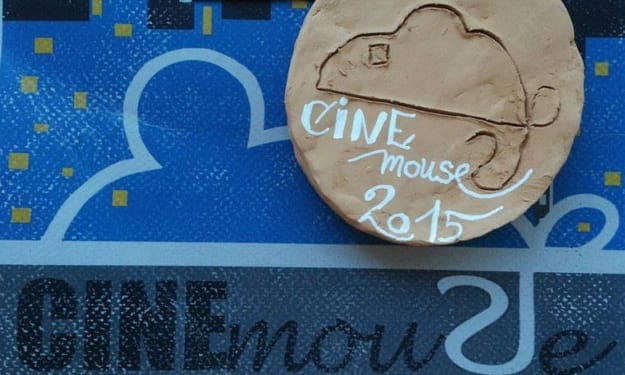
The Story of CineMouse
From Facebook Fans to Film Academy: The Story of CineMouse In 2015 in Bulgaria, an era when cultural institutions struggle to gather audiences while audiences effortlessly gather online, a curious reversal occurred in Bulgaria: a Facebook group became a film academy. What began as daily conversations about cinema evolved into a real ceremony, a real community and finally real awards. The project was called CineMouse, and behind it stood professor Peter Ayolov from Sofia University — lecturer in Media Scriptwriting and author of the book The Media Scenario (2026).
By Peter Ayolov24 days ago in History
Copyrighting the Self: Manufacturing Mirror Selves
Review: Peter Ayolov — Copyrighting the Self: Manufacturing Mirror Selves Peter Ayolov’s book proposes something more ambitious than a cultural critique of social media or a philosophical reflection on identity in the digital age. It attempts a reclassification of the human being under conditions of technological mediation. Rather than asking how media influence people, the text asks what kind of being becomes possible once recognition, representation and interpretation precede encounter. The work therefore belongs less to media studies than to philosophical anthropology. Its central claim is simple but radical: contemporary society has moved from interacting with persons to interacting with authorised representations of persons, and this shift changes the structure of existence itself.
By Peter Ayolov24 days ago in BookClub
The Speaking Mirror
The Speaking Mirror: Language After Humans The twentieth century believed that language was humanity’s highest achievement. The twenty-first century quietly discovers that language was only a transitional technology. What people called thought, debate, knowledge, education and culture increasingly reveals itself as a narrow biological interface — a slow and lossy channel through which an organism tried to handle complexity larger than its memory. The arrival of large language models exposes this limitation not gradually but brutally. For the first time a system appears that does not merely store texts but inhabits their relations. The consequence is unsettling: the history of language has outgrown its creators.
By Peter Ayolovabout a month ago in Critique