Theme
What is a Valentine?
What really is a valentine? Is it flowers usually roses, but could be any variety or is it candy that comes in heart-shaped boxes or even is it just a special greeting card expressing something that may be kind of hard to write or say yourself or could it be just a little homemade card that says "I Love You Happy Valentine's Day? Is it only a day for couples what if you are a single? Could this day be for just friends too just like in elementary school without the 'party'? Just wondering and have a Happy Valentine's Day!
By Mark Grahamabout a month ago in Critique
What is a Valentine?
How many out there remember those Valentine's Day parties you had in elementary school? You know when the night before you had to buy cards some with various treats to give to all your classmates or not. In school during art class, you had to decorate paper bags somehow with hearts and whatever to depict this day lined up along the bottom of the bulletin board in the back of classroom. You would deliver these cards and place them in the bags, and then at the end of the day with ice cream, chips and cookies you would open it.
By Mark Grahamabout a month ago in Critique
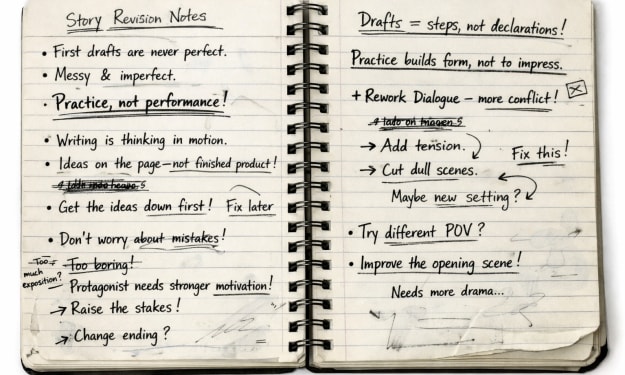
Practice vs Performance
One of the quiet pressures shaping modern communication is the assumption that anything written should be immediately shareable. Drafts blur into declarations, and exploration is mistaken for conclusion. Under this pressure, writing becomes performative by default. The moment words are placed on a page, they are treated as finished statements rather than steps in a process. This expectation distorts both how writing is produced and how it is received, collapsing practice into performance and leaving little room for genuine development.
By Peter Thwing - Host of the FST Podcastabout a month ago in Critique
AI as a Reflective Surface
Much of the confusion surrounding artificial intelligence comes from treating it as an agent rather than a surface. When people speak about AI “doing the thinking,” “creating the ideas,” or “speaking for someone,” they are often projecting agency onto a system that does not possess intention, belief, or understanding. This projection obscures what is actually happening in many real-world uses. In those cases, AI is not acting as a source of meaning, but as a surface that reflects, redirects, and reshapes what is already present.
By Peter Thwing - Host of the FST Podcastabout a month ago in Critique
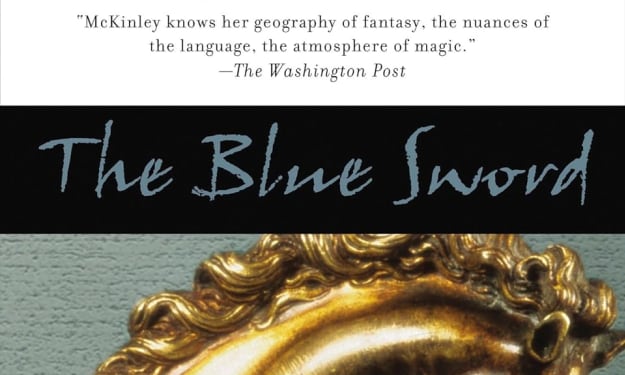
The Blue Sword
The Blue Sword by Robin McKinley Nothing says a childhood classic like white savior Mary Sue! I snagged this one after listening to an episode of Brandon Sanderson’s podcast where he said this inspired one of the stained glass windows decorating his house (because of course he has presumably awesome stained glass windows).
By Matthew J. Fromm2 months ago in Critique
When Is a Move Final?
The Commitment Problem in Modern Chess Modern chess operates under a fractured commitment model that no longer aligns with how players think, how turns function in most games, or how chess itself is actually played across physical and digital formats. At the heart of the problem is that chess treats physical contact with a piece as binding commitment while simultaneously relying on a separate explicit action to end a player’s turn. This creates a logical contradiction: a move becomes final before the turn is over. In most turn-based games, interaction with game components is provisional until the player explicitly signals the end of their turn. Chess is an anomaly in this respect, and the inconsistency becomes increasingly visible in modern play.
By Peter Thwing - Host of the FST Podcast2 months ago in Critique
Countdown to Pearl Harbor: The Twelve Days To The Attack
Countdown to Pearl Harbor: The Twelve Days To The Attack by Steve Twomey I really wasn’t expecting much of this read; I grabbed it while I was at Pearl Harbor because how could I not get a book while I was there?
By Matthew J. Fromm2 months ago in Critique