science fiction
The bridge between imagination and technological advancement, where the dreamer’s vision predicts change, and foreshadows a futuristic reality. Science fiction has the ability to become “science reality”.
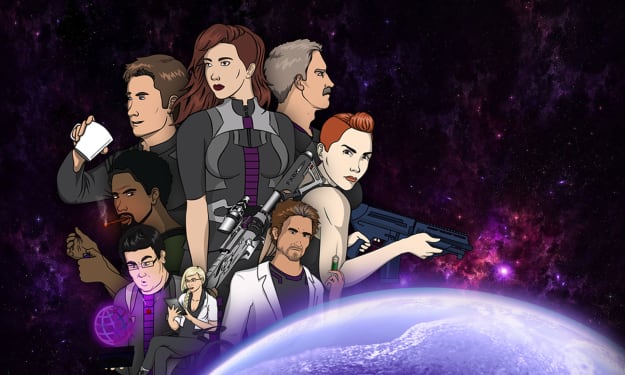
Lost Hope Creator Jeff Saamanen
Lost Hope is a comedic sci-fi epic with mature themes and dramatic overtones; or, as we like to call it, Archer meets Star Wars. Lost Hope, created by real life sci-fi couple Jeff Saamanen and Natalie Harvey, follows the exploits of Clara Hope and her team after the unexpected destruction of planet Earth. Together with her inexperienced crew of the USS Hopeful, Clara is forced to protect what remains of our species from the vast unknown of the universe.
By Natasha Sydor10 years ago in Futurism
How to Analyze a Science Fiction Film
I like to time travel, so I love science fiction. Unlike other genres of film, science fiction warrants its own criteria to be effectively evaluated. First, like any film, we measure a movie for its entertainment value: cinematography, acting, and plot (the basics). Science fiction cinema has an extra step. Audiences have to ask, is this good science fiction? The most important thing to realize when learning how to analyze a science fiction film is that qualifying as sci-fi takes more than putting actors on a stage set in space. Plenty of films purport to be science fiction but fall flat under analysis, because they fall back on fantasy or rely on absurd logic.
By Futurism Staff10 years ago in Futurism
Best Isaac Asimov Books
Often known to say that he did not fear computers, Isaac Asimov was truly fearful of the lack of computers. Isaac Asimov's imagination is synonymous with prophetic visions of the future. On science, he said, "The most exciting phrase to hear in science, the one that heralds new discoveries, is not 'Eureka!' (I've found it!), but 'That's funny...'" At one point, Isaac Asimov served as the Vice President of the MENSA organization. He referred to his colleagues in MENSA International as "brain proud" and quite passionately raved about their IQs. A genius among geniuses, Isaac Asimov's contribution to science fiction literature stands alongside those of his contemporaries, and his books surely rival the best Arthur C. Clarke books and the greatest works of Robert Heinlein. Whether I, Robot or I, Asimov – the author's memoir – is your book of choice, celebrate this iconic author with the best Isaac Asimov books.
By Natasha Sydor10 years ago in Futurism
Yar's Plume
It was uncomfortably chilly on the night we saw each other last. I remember the methane snowflakes and the carbon ice, the first time around. The landscape around the Plume had an unusually eerie feeling. Even a really long displacement such as the one I was going through now could not approximate the feeling. The memory somehow made the hair on my back rise. A distant, logical, and pedantic part of my troubled, aching mind sought to inform the other part—the instinctive, impulse-driven part—that technically, I had no hair. No back for that matter either.
By Vasileios Kalampakas10 years ago in Futurism
Java From Hell-Coffee Enhances Super Powers
I should’ve seen it coming when I first saw it. When I saw my guy pal Bob Bloch- flying. Literally! I found that a particular affront, considering that, underneath my modest disguise of a human being like you and everyone else on this planet, I am, in fact (cue the echo chamber):
By David Perlmutter10 years ago in Futurism
Roadside Picnic and Stalker Similarities
In the eyes of science fiction author Ray Bradbury, the only crime worse than burning books is not reading them at all. We all remember books our own way. Focusing, forgetting, glazing over, missing parallels, inventing others; we embellish. When talking about a book with other people, I often wonder if we even read the same book—or, somehow, two things with the same title by the same author. It’s like we’ve both seen a whale in the water at one point in our lives, and we’re trying to determine the shape of its eyes. Obviously, there's some overlap, a little play in the bones, but it’s more of a Venn diagram than a flowchart, a sort of private film that plays for each reader, renewed with each read, every scan a fresh translation. Neither film nor literature exists as Object. Rather, each can be reduced to a set of stimuli floating in space, never in one place at one time. Not even at the site of mind.
By Reynard Seifert10 years ago in Futurism
The Watcher
From the dome of his mile-long tower, peeking above the cracked earth of a former schoolyard, Dalen studied a wall of sulfuric storm clouds overshadowing the husks of Chicago’s skyline. One level below, a window wrapped around the tower’s shaft overlooked the hidden city, laid out like the layers of an onion. Were the city lifted to the surface, it would look like a giant toy top. The carved streets and homes lay open like a labyrinth, lit by cauldrons of engineered glowworms hanging from the cavern ceiling.
By Sequoia Nagamatsu10 years ago in Futurism
H.E.L.G.A. - A Tale of Artificial Intelligence
December 20 - 5:32 AM (Miami time) 10:32 GMT An Undisclosed Secure Location Up to this point, HELGA had been following the complex set of instructions which Jay-L created for her as part of an emergency action list to be executed in the event that he could not be located. Part of the list of tasks included several methods of determining the nature of Jay-L’s disappearance. If the circumstances surrounding his absence were suspicious, then she had very specific orders she was to follow. Once she determined the high likelihood that Jay-L was being pursued for capture by the Special Forces Delta Group, under direct order of the U.S. President, a whole new set of options became available to her as a means of responding. However, HELGA had finally exhausted the myriad of options on that detailed list of instructions which Jay-L had prepared in the event of his capture at the hands of the government.
By Lucian Randolph10 years ago in Futurism
Ben Bova Interview
"Don't ask your readers to admire your words when you want them to believe your story." Science Fiction author Ben Bova realized that the general rules of science - don't add an experiment to an experiment, and don't make things overly complicated - also applied to science fiction. His theory certainly brought him success. Starting out as a technical writer for Project Vanguard in the 1950's, Ben Bova went on to become a successor to John W. Campbell as editor of editor of Analog Science Fact & Fiction where he won six Hugo Awards. Throughout his career he authored over 120 books on science fact and science fiction, worked as editorial director for OMNI magazine, and was president of both the National Space Society and the Science Fiction Writers of America. He has appeared as the Guest of Honor at the Florida convention Necronomicon on two separate occasions, and in 2000, he attended the 58th World Science Fiction Convention as the Author Guest of Honor.
By Claire Evans10 years ago in Futurism
Darkening Day
Remember when The Curtain went up? The only viable solution, extreme as it was, to save humanity from Earth's rapidly hyper-toxifying, invisibly over-saturating air. A superstructure, ten miles up, of floating chemical filters, each a sort of box-shaped balloon, converting noxious chemicals into safer ones. Billions of them, linked together into an edgeless shell spanning the entire globe.
By Breyen Katz10 years ago in Futurism