Latest Stories
Most recently published stories in Journal.
How To Decide The Ideal Length Of Stay In The Maldives
Figuring out how long to spend in the Maldives isn't as straightforward as you might think. Sure, everyone wants to maximise their time in paradise, but there's a science to getting it right. Too short and you'll barely shake off the jet lag before heading home, too long and you might find yourself restless (or broke!). Let’s walk through how to nail down the perfect duration for your trip.
By Jeewanthi Armstronga day ago in Journal
52 Years in the Making: 5 Lessons I Learned from My "Successful" Friends
I am a so-called “creative” person—always have been and probably always will be. Unfortunately, I’ve battled with that realization for years. You see, the world taught me that success came from following a traditional path, and I tried to buy in. I’ve struggled and fallen behind (professionally). My challenge between finding a home in the world I feel I belong in, and the one that society wants me to live in has been a long-standing heavy ball and chain. It’s kept me from experiencing life the same way people around me do.
By Matt Reichera day ago in Journal
The Wayback Machine for My DNA: When Genealogy Gets Gritty
I’d recently subscribed to a newspaper historical archives service in order to do research for an article. In a fleeting moment of a little too much free time and nothing on TV, I put the names of a couple of my family members into the search box to see what would happen.
By Matt Reichera day ago in Journal
Ukulele: Complete Guide, History, Types, Uses, Learning, and Modern Impact. AI-Generated.
The ukulele is a small string instrument that started from Portuguese roots and became famous in Hawaii before spreading worldwide. Today, it is one of the easiest instruments to learn and is widely used by beginners, students, and musicians across the world.
By Backlinks Carta day ago in Journal
How to Explore Tea Plantations and Tranquil Views in Ella, Sri Lanka
Ella is one of those places that feels gentler the longer you stay. Tucked into Sri Lanka’s hill country, this small mountain town is known for its rolling tea estates, shifting mist, and viewpoints that seem to change character by the hour. It is not loud or hurried. Ella invites you to slow down, to notice the landscape, and to move through it at its own pace.
By Jeewanthi Armstrong2 days ago in Journal
Why Choose Luang Prabang for a Spiritual Retreat?
Luang Prabang in Laos is a quiet city that is situated between the Mekong River and Nam Khan River. It is a UNESCO World Heritage town known for its beautiful temples and colonial era buildings. Luang Prabang has a peaceful atmosphere that makes it perfect for those looking for a mindful retreat away from the stresses of daily life.
By Jeewanthi Armstrong2 days ago in Journal
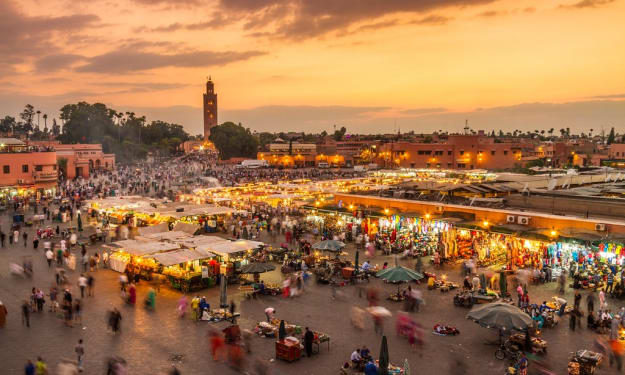
Planning Your Marrakech Adventure
Marrakech is a city that overwhelms the senses in the best possible way. The call to prayer drifting over terracotta rooftops, the scent of spices hanging in the air, and the constant hum of voices and movement all hit at once. With the right approach, Marrakech becomes an immersive journey through history, culture, and colour that stays with you long after you leave.
By Jeewanthi Armstrong2 days ago in Journal
The Cost of Global Hegemony: An Analytical Study of Human Costs Since 1492. AI-Generated.
The story began in 1499 when an Italian explorer set foot on the continent that we now call America. This so-called discovery proved to be a great human tragedy for the original inhabitants, as the ruthlessness with which indigenous civilizations were wiped out in the struggle for resources is a sad chapter in history. The foundation of the American continent was laid on the desecration of innocent people who were targeted simply because they were an obstacle to the economic goals of the colonial powers. During various periods of European colonialism, millions of indigenous people living there were eliminated through forced evictions and systematic operations in order to lay the foundation for a new state. When independence was declared in 1776, its benefits were limited to a select few, while for the indigenous population and the millions of people who were forcibly brought in, these chains became even tighter. The policies adopted by the American state to expand its borders wiped out every nation and civilization in its path. From the beginning of the twentieth century, this state began to go beyond its borders and intervene from the Philippines to Cuba, the sole purpose of which was to protect its economic interests. At the end of World War II, when the world was looking for peace, the nuclear attacks on Hiroshima and Nagasaki proved that any human limit can be crossed in the pursuit of power. This was the turning point from which this state established its role on the global stage, which plunged the world into the fire of constant conflict. In the name of the Cold War, the entire world was divided and dozens of countries were turned into laboratories. More than three million human lives were lost in the Korean War, while the operations that continued for fifteen years in Vietnam not only targeted humans but also devastated the land there with toxic chemicals. Behind all these measures lies the interest of the arms manufacturing industries, which can only thrive in the event of confrontation. This is why, in the last eight decades, there has hardly been a year when this state has not been directly or indirectly engaging in some kind of adventure in some region. These attacks have always been presented in the attractive words of “democracy and freedom” to appease the global conscience, but now it is time to bring the facts to the world that this system itself has become the biggest challenge to world peace.
By Malik Sarfraz Hussain Awan2 days ago in Journal